About Amanita velosa (Peck) Lloyd
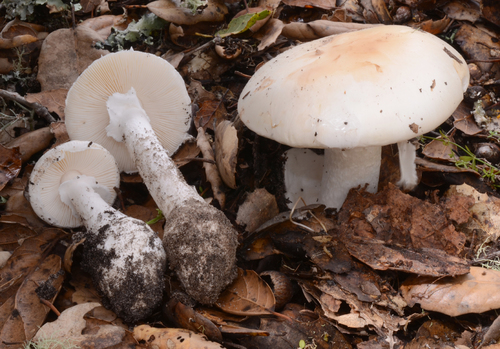
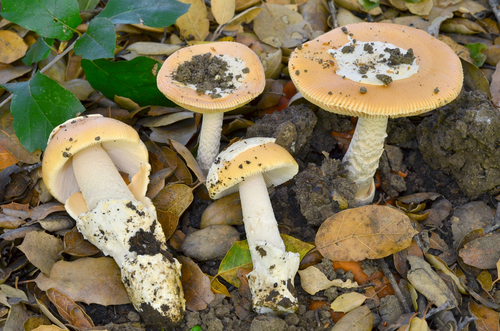
This species belongs to Amanita section Vaginatae, and like other species in this group, it lacks an annulus, has a striate pileus margin, thick universal veil remnants that form the veil, volva, and pileus patches, inamyloid spores, and does not contain characteristic Amanita toxins such as amatoxins and ibotenic acid. It can be distinguished from other species in section Vaginatae by the complete absence of an umbo on its pileus, its short pileus striae, and its distinct pale orange to pale salmon coloration when young. As it ages, its color may become more brownish, and entirely white specimens are occasionally observed. Like many other Amanita species, its gills are white, but they can occasionally have a distinct pinkish or orangish tint. In older specimens, the odor may become pungent and fishy. The cap ranges from 5–15 cm wide, starting convex before flattening into a plane shape; it is typically orange-pink or salmon-like in color, and usually bears a white patch of universal veil. The gills are adnexed to free, closely spaced, and white (or turn pinkish with age). The stalk is 5–15 cm long and 1–3 cm wide. The volva is white, saclike, and sheathes the base of the stalk. The spores are white, smooth, elliptical, and inamyloid. In its range, A. velosa is a late-season mushroom. It is primarily found in the coastal regions of California, Oregon, and Baja California, growing from midwinter until the end of the California rainy season. Its preferred habitat is the ecotone between oak (particularly coast live oak) woodlands and open grassland, where it forms an ectomycorrhizal relationship with young oak trees. The species has also been reported growing in association with aspen and conifers in the Sierra Nevada, with one additional report of a specimen found growing with spruce in Great Smoky Mountains National Park in the eastern United States.