About Amanita thiersii Bas
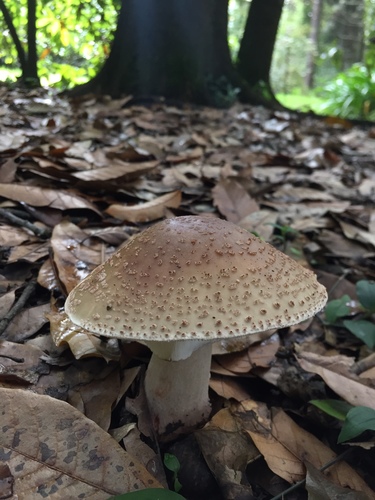
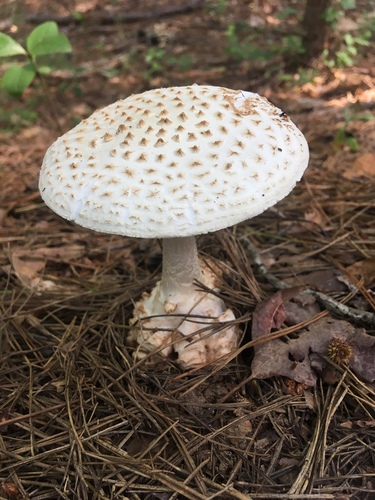
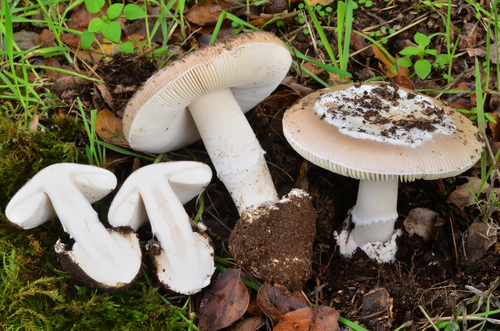
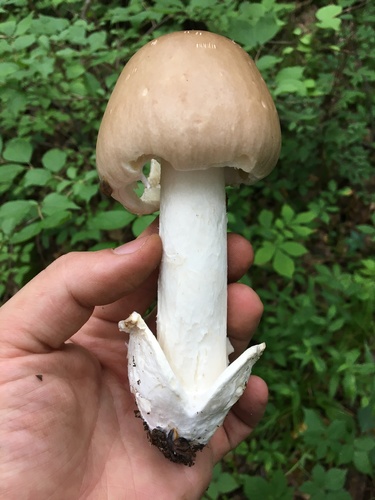
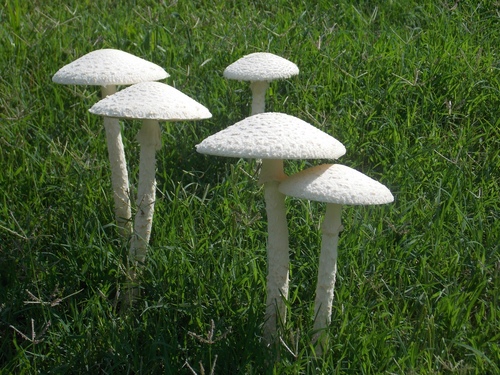
Amanita thiersii Bas (also referred to as Saproamanita thiersii) has a white, dry cap that is 3.5–10 centimetres (1+1⁄2–4 inches) wide and convex in shape, either conical or plano-convex. The cap often has a broad, low umbo, and its flesh can be up to 10 millimetres (1⁄2 in) thick. When young, the cap is covered in soft, white fragmentary remains of the universal veil; these fragments become more widely spaced as the cap expands, and are shaggy and somewhat sticky. The gills vary in length, are free from the stipe, and range from crowded to widely spaced. They may be narrow or broad, and are white to creamy yellow in color. The stipe is white, measuring 8–20 cm (3–8 in) long and 10–20 mm (1⁄2–3⁄4 in) wide. Some specimens have stipes that bruise yellow; the stipe is either hollow or lightly filled with cottony tissue. The basal bulb is slightly broader than the rest of the stipe, 2.5 cm (1 in) long and 2.2 cm (7⁄8 in) wide. A shaggy, drooping ring is present on the stipe, but it is often shed before the mushroom reaches maturity. Spores of A. thiersii are white, roughly spherical, measure approximately 7.8–9.8 by 7.3–9.0 μm, and are amyloid. Analyses of fruit bodies have isolated both monokaryotic (one nucleus per cell) and dikaryotic (two nuclei per cell) strains. All observed spores are binucleate, but researchers suggest that in monokaryotic strains the second nucleus failed to pass through the germ tube during germination. The mushroom's odor is indistinct when young, but becomes unpleasant with age, resembling rot or cheese. Its taste is described as oily bitter, or bitter metallic. A. thiersii may be accidentally collected and mistaken for an edible species because it grows on lawns among grasses, unlike most other Amanita species which grow near trees in forests. It can be distinguished from other white grassland fungi by its fluffy cap, though the white veil fragments may wash away with rain. It looks similar to a number of other Amanita species. It can be told apart from A. praegraveolens microscopically by the absence of clamp connections between cells in A. thiersii. Both A. thiersii and A. aureofloccosa have hollow stems, but A. aureofloccosa has a more tapering stipe and the entire fruit body is more yellow. A. silvifuga also grows in grassland habitats in Texas, and H. D. Thiers noted that both this species and A. thiersii have a bitter taste. A. thiersii can be distinguished from A. silvifuga by the latter's darker coloration and more heavily warted cap. A. thiersii inhabits lawns, pastures and prairies throughout the Mississippi River Basin. It often forms fairy rings or arcs, but sometimes produces fruit bodies as isolated individuals, and has been found growing in the same lawn as Chlorophyllum molybdites. Stable carbon isotope analysis has confirmed that this mushroom is saprotrophic, unlike other Amanita species which are mycorrhizal. Fruit bodies grow from mid or late summer until early fall. Since it was first recorded in 1952 in Texas, the species has expanded its range. It appeared in southern Illinois in the 1990s, and has since spread to central Illinois, where it is the most common mushroom found in lawns during July and August. Currently, it is found in nine U.S. states: Missouri, Oklahoma, Texas, Kentucky, Ohio, Kansas, Iowa, Indiana, and Illinois. It also occurs in Mexico. Like most of its close relatives, the species is suspected of being toxic. Handling the mushroom is harmless; poisoning only occurs if it is ingested. One suspected case of A. thiersii poisoning has been reported from the state of Puebla, Mexico, and the outcome of this case is unknown. Reported symptoms in humans include reversible impairment of kidney function. A Meixner test confirmed that amatoxins were not responsible for the Puebla poisoning case. In Mexico, the species is harvested under the Spanish name hongos de neblina.