About Amanita silvicola Kauffman
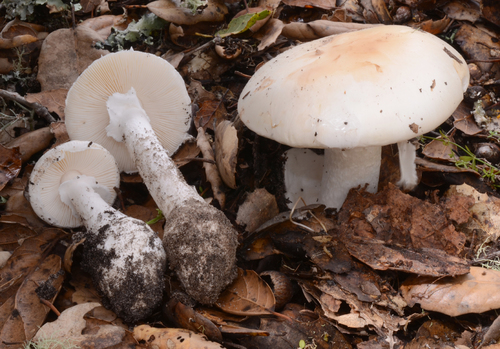
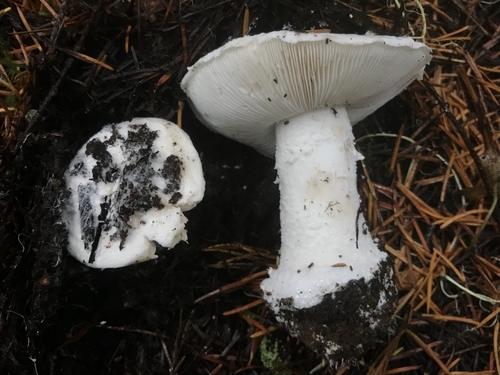
The cap of Amanita silvicola is 5 to 12 centimetres (2 to 4 3⁄4 inches) wide, dry and pure white. It starts out rounded and later flattens; in advanced age or when decaying, it may develop discoloration, forming what Kauffman observed as "bright rose-colored spots and streaks". Young fruiting bodies are covered by a fluffy, continuous universal veil, which breaks into irregular soft powdery patches across a slightly sticky surface, rather than forming firm warts. The cap flesh thins significantly near the margin, which stays incurved until the mushroom reaches maturity. The gills are white, crowded, and have a free to narrowly adnate attachment; sometimes they extend toward the stem in a decurrent tooth. They are medium broad at 6–7mm, have cottony edges, and project below the cap margin when mature. The spores measure 8.0–10.0 μm by 4.2–6.0 μm; they are smooth, amyloid, ellipsoid, and colourless, producing a white spore print. The stem is 5 to 12 cm long and 12 to 25 mm thick. It is stout, tapering slightly as it connects to the cap, and sometimes bears a slight ring near the cap. A. silvicola rarely forms a rooting base, and has a basal marginate bulb (distinctly separate from the stem) at its base, around 3–4 cm thick, with wooly veil remnants on the bulb margin. The mushroom's flesh is white and does not change color when cut. It can be told apart from most other white Amanita species by its short stalk. Its edibility is uncertain, but because it closely resembles the poisonous species A. smithiana, which shares a similar distribution range, consumption is strongly advised against. Amanita silvicola occurs in the Pacific Northwest of North America and California, and is found more rarely in the Sierra Nevada mountains. The IUCN Red List has assessed this species as Least Concern, with a stable population that is "locally common" in the Pacific Northwest and California. A. silvicola is a terrestrial species; it grows either solitary or in small groups in coniferous woods, especially under Western hemlock, and prefers areas with high rainfall.