About Amanita roseotincta (Murrill) Murrill
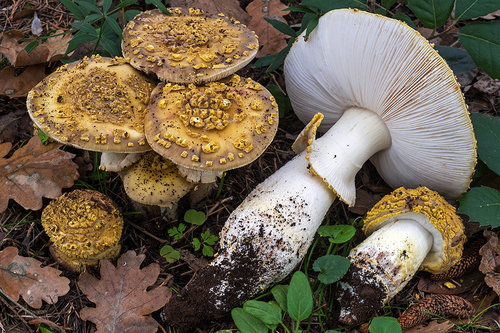
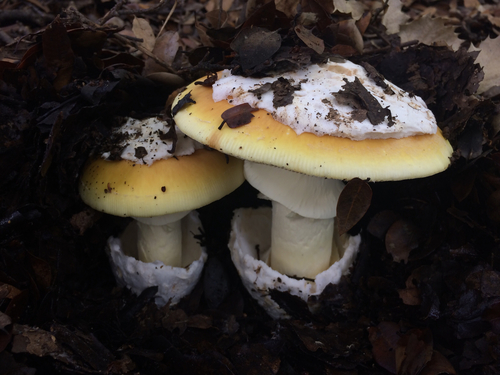
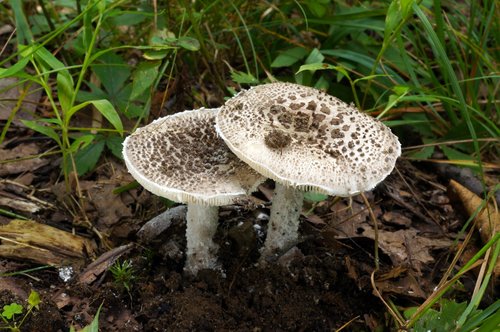
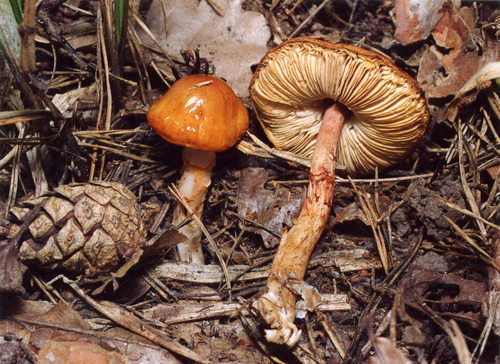
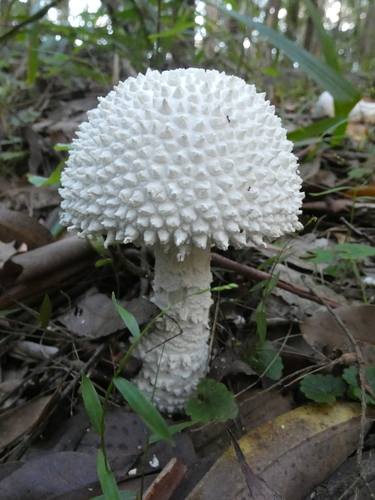
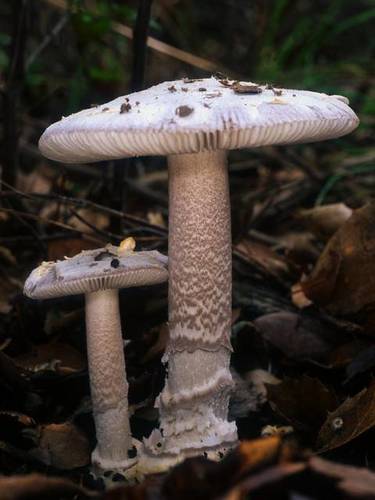
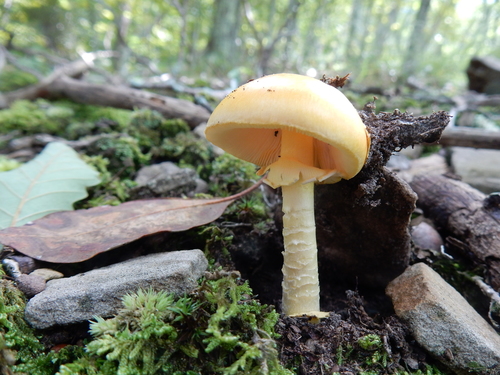
Amanita roseotincta is a medium-sized Amanita mushroom. Mature specimens have a cap 35 to 65 millimeters wide, and a stipe that measures 25 to 150 millimeters tall and 5 to 20 millimeters wide. Like other Amanita mushrooms, young A. roseotincta first emerges in an egg or button shape, enclosed by a universal veil. This species' universal veil is distinct, with two separate layers. The upper layer leaves off-white pyramidal warts on the cap that dislodge easily and darken quickly. The lower layer of the universal veil and the partial veil leave a powdery salmon to pink residue that fades quickly, and this residue appears on the cap, the underside of the ring, and the stipe. When the cap is fully expanded, it ranges from convex to flat, and sometimes has striations along its edges. The underlying cap color is cream to white; the cap surface is dry and sometimes has a slight sheen, though this can be covered by remaining veil fragments. The gills are free, close together, and white to cream, and the species produces a white spore print. The stipe is also cream-white under a layer of pink to beige powder, with more powder concentrated closer to the cap, and it can bruise reddish when damaged. The stipe ends in a swollen, round or elliptoid base that is usually at least partially buried underground. Salmon-orange fragments of the universal veil may remain around the volva. When fresh, a skirt-like ring is present on the stipe. The ring is pink-beige to white, striate on its upper surface, and powdery pink on its lower surface, but it is thin, fragile, and easily disturbed or lost entirely. Because of its unique veil remnants, which easily dislodge and quickly change color when exposed to light, this mushroom can look very different at different stages of development. Warty, vivid orange powdery young buttons become relatively unremarkable off-white Amanitas with faint residual tan to beige powder on the cap over time. Pink and orange coloration lasts longer on the upper stipe and the underside of the ring than it does on the exposed cap. A. roseotincta sometimes has a faint, apricot-like odor, which is most noticeable in large collections of the species. Microscopically, A. roseotincta is distinguished by its ellipsoid, smooth, thin-walled, inamyloid spores, which measure between 8.5-11.8 micrometers by 6-8.2 micrometers. The basidia of this species do not have clamps at their base. Amanita roseotincta is found in the United States, ranging from New Jersey south to Florida, and extending west as far as Texas. It grows both singly and in groups in pine and mixed-pine forests. Amanita guzmanii, a very similar species native to southern Mexico, is a suspected synonym of A. roseotincta pending further research. If this synonymy is confirmed, the known range of A. roseotincta extends farther south than previously recorded.