About Amanita regalis (Fr.) Michael
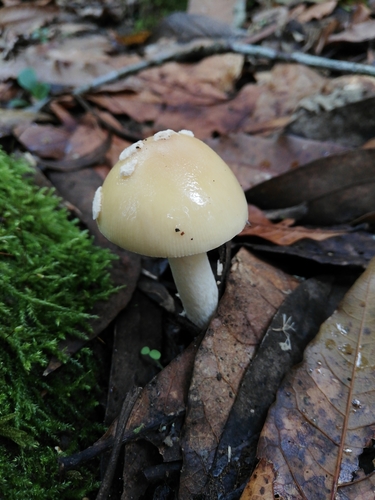
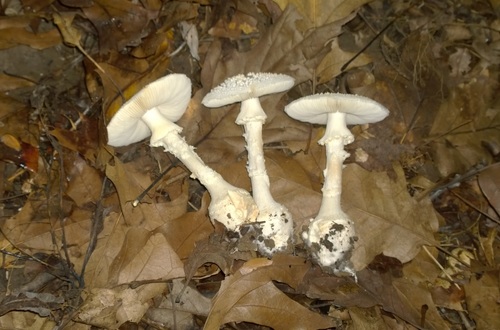
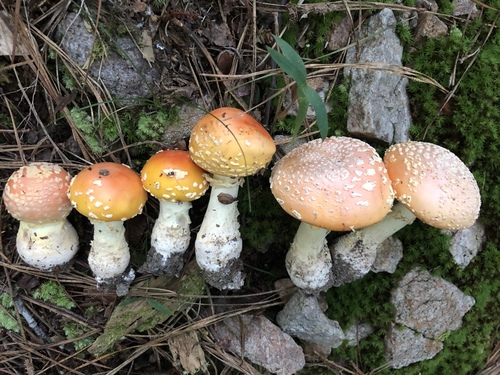
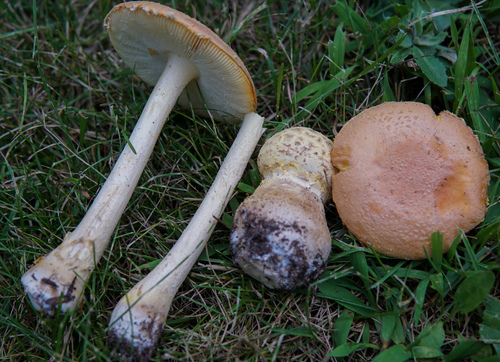
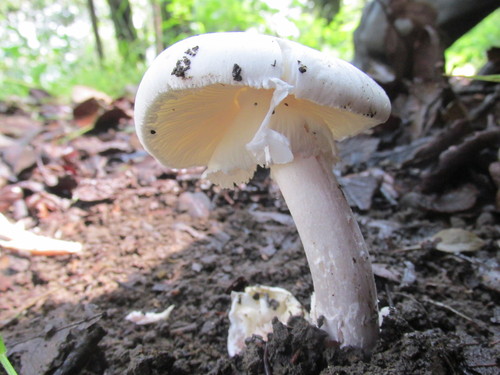
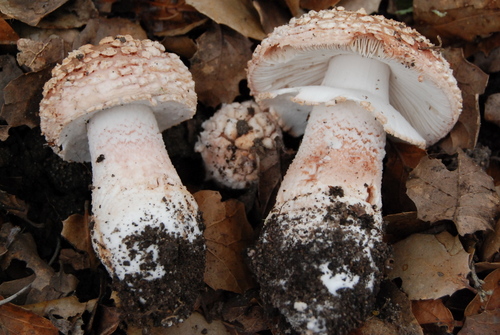
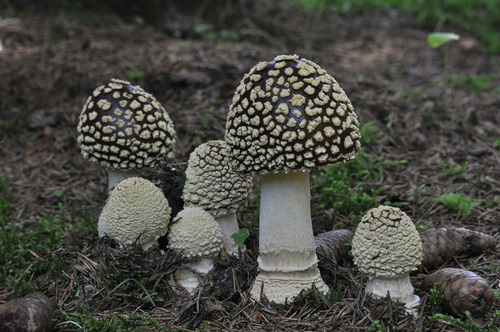
Like all species in the Amanita genus, most of the Amanita regalis organism exists underground as a symbiotic partner to certain tree species. The visible fruit body of the fungus is its reproductive structure, which only emerges when environmental conditions for moisture, temperature, and nutrient availability are suitable. The cap of A. regalis measures 10 to 25 centimetres (4 to 10 inches) across. Depending on its developmental stage, the cap can range in shape from spherical, to convex, to somewhat flattened. It is yellowish brown, and densely covered in yellowish to light ochraceous scabby warts arranged in nearly regular concentric rings. These rings are remnants of the volva, left behind when the young fruit body expands. The cap is fleshy, and mature specimens have grooves along the margin that extend 1.5 to 2 cm (1⁄2 to 3⁄4 in) inward. The cap cuticle can be peeled away from the cap flesh almost to the center. The gills are tightly crowded, do not attach to the stem, and are white with a creamy yellow tint. Gill edges are floccose, meaning they bear tufts of soft wooly hairs, which are another remnant of the volva. The stem of a mature A. regalis is typically 10 to 20 cm (4 to 8 in) long and 1.5 to 2 cm (1⁄2 to 3⁄4 in) wide, widening at the base into a bulb decorated with 2–4 rings of small, scale-like, lemon or ochre-yellow warts. The entire stem and ring are not pure white, and carry a faint yellowish tinge. The mushroom's flesh is whitish, with a faint yellow tint in the stem, and golden yellow just under the cap cuticle. The flesh does not change color when exposed to air, and has an unremarkable taste and smell. A. regalis is more common in northern Europe than in southern Europe, and has not been recorded from southern and western Europe. In addition to being common in Scandinavian countries, it has been collected in Germany, Hungary, Latvia, Russia, Slovakia, and Korea. In North America, it is only found in Alaska, where it usually grows above the tree line. It is a rare species that typically grows on the ground in mountainous forests, both deciduous and coniferous. It is a mycorrhizal fungus that forms a symbiotic relationship with certain tree species: its fine underground mycelial threads wrap around tree roots, supplying the trees with needed minerals, trace elements, and water from the soil, while the tree provides the fungus with carbohydrates it produces via photosynthesis. Experiments have confirmed that A. regalis forms mycorrhizae with birch, Scots pine, Mountain pine, and Norway spruce. Fruit bodies have been recorded growing in fairy rings. Amanita regalis is poisonous. One poisoning incident was documented in Finland, where three people misidentified the mushroom as the edible parasol mushroom Macrolepiota procera. Poisoning symptoms began 1–2 hours after ingestion, and were primarily gastrointestinal: nausea and severe vomiting. Two people also experienced central nervous system effects and cholinergic symptoms, including hallucinations, confusion, loss of consciousness, profuse salivation, and sweating. All three people recovered within 4–24 hours, with no lasting damage to the liver, kidneys, or central nervous system. This incident shows that cooking does not completely neutralize the toxic compounds in A. regalis. Chemical analysis confirms the species contains ibotenic acid and muscimol, the same toxic compounds found in Amanita muscaria. A. regalis can bioaccumulate vanadium, a trait first recorded in A. muscaria in 1931. A field study of Scandinavian specimens found vanadium content ranging from 38 to 169 mg per kg of dry mushroom, with an average of 119 mg/kg. By comparison, vanadium concentration in most other mushrooms is typically less than 2 mg/kg.