About Amanita porphyria Alb. & Schwein.
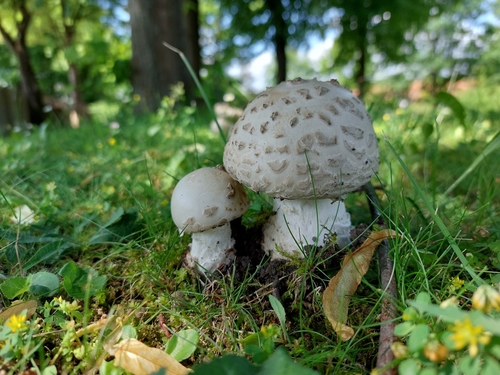
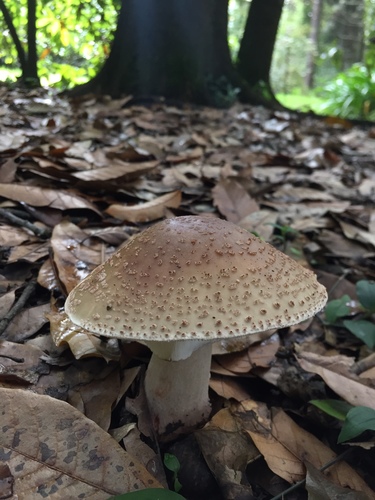
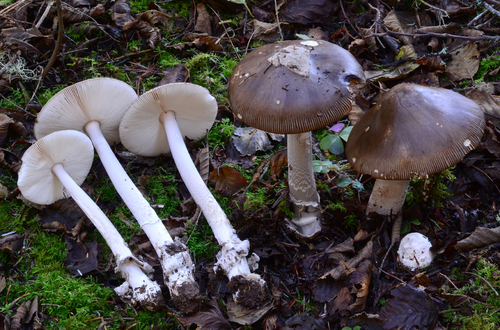
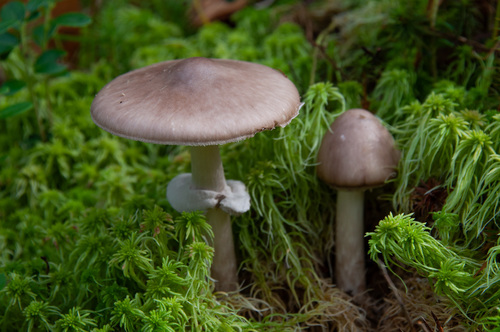
Amanita porphyria Alb. & Schwein. has a smooth cap that is hemispherical when young and becomes flat with age, sometimes bearing grey patches of partial veil. The cap ranges from 4 to 10 centimetres (1+1⁄2 to 4 inches) in diameter, and is brown with either a purplish or greyish hue. Like other species in the Amanita genus, this fungus has whitish, free gills that do not attach to the stem, and produces white spores. The gills darken when bruised. The stem measures 5–12 cm in height and 0.6–1.5 cm in thickness, and ends in a basal bulb that may or may not be surrounded by a white membranous volva. The fragile stem ring is grey-violet or blackened. The flesh is white, and smells of raw potato or radish. Its amyloid spores are nearly spherical, with a diameter of 8–10 μm. This species forms mycorrhizae, living in symbiosis with trees, and typically grows on poor soil under coniferous trees—especially spruce, but also fir and hemlock—as well as some deciduous trees like birch. It fruits from summer to autumn, and is more common in mountains or further northern regions. In Europe, it is very common in boreal or hemiboreal forests, and less common in temperate areas. It is also found across northern North America from east to west. While there was once uncertainty whether North American specimens should be classified as a separate species, DNA evidence now confirms all variants belong to the same species. It has also been recorded in Australia. Amanita porphyria is not suitable for consumption. A major risk is that it can easily be mistaken for far more poisonous species, such as Amanita phalloides, the death cap.