About Amanita phalloides (Vaill. ex Fr.) Link
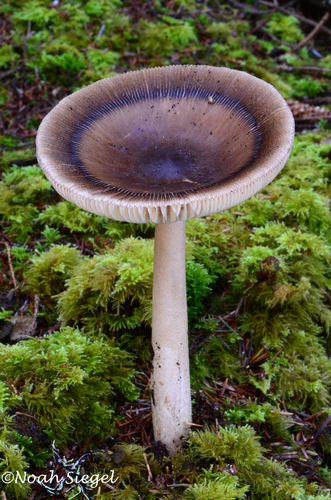
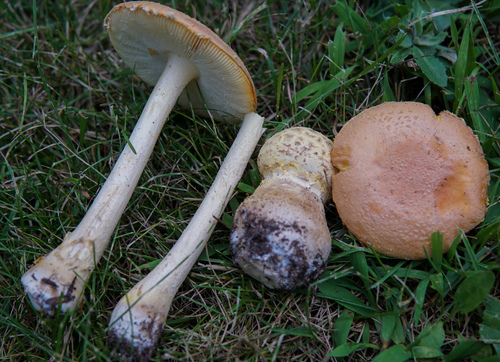
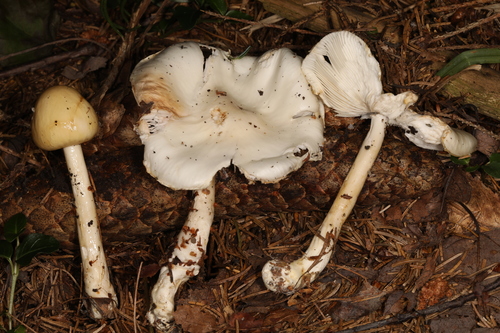
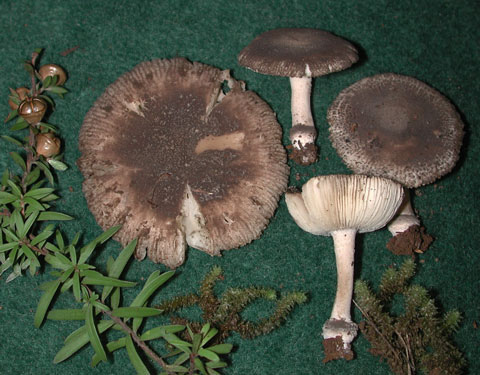
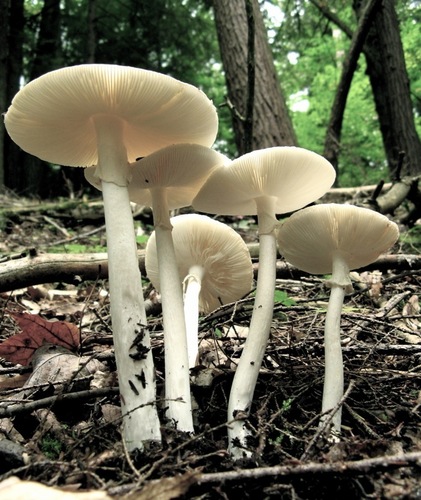
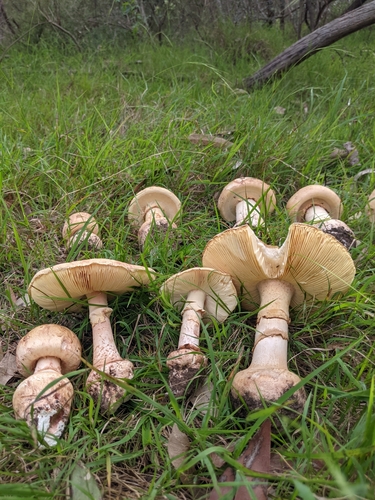
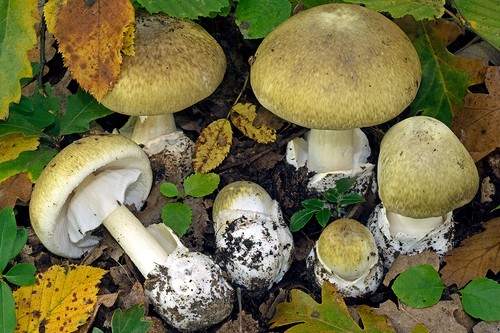
This species, commonly known as the death cap, produces a large, prominent above-ground fruiting body (basidiocarp). Its cap (pileus) is typically 5 to 15 cm (2 to 5.8 inches) across; it starts rounded and hemispherical, and flattens as it ages. Cap color can be pale-green, yellowish-green, olive-green, bronze, or white in one form, and is often paler toward the margins, which may bear darker streaks. Caps also often become paler after rain. The cap surface is sticky when wet and easily peeled, a trait incorrectly associated with edible fungi that contributes to misidentification. Remnants of the partial veil form a skirt-like, floppy ring (annulus) that usually sits 1 to 1.5 cm (3⁄8 to 5⁄8 in) below the cap. The crowded, white gills (lamellae) are free, meaning they do not attach to the stipe. The white stipe (stem) is 8 to 15 cm (3+1⁄8 to 5+7⁄8 in) long, 1 to 2 cm (3⁄8 to 3⁄4 in) thick, scattered with grayish-olive scales, and has a swollen, ragged, sac-like white volva (base) at its bottom. The volva is a distinctive diagnostic feature, so it is important to clear away debris to check for it, as it can be hidden under leaf litter. Spores are 7-12 x 6-9 μm, smooth, ellipsoid, and amyloid. The odor is initially faint and honey-sweet, and intensifies over time to become an overpowering, sickly-sweet, objectionable scent. Young specimens first emerge from the ground looking like a white egg covered by the universal veil; the veil later breaks, leaving the volva as a remnant. The spore print is white, a common trait of Amanita species. Transparent spores are globular to egg-shaped, 8–10 μm (0.3–0.4 mil) long, and stain blue with iodine. Gills stain pale lilac or pink when exposed to concentrated sulfuric acid. Death caps are native to Europe, where they are widespread. Their native range extends north to southern coastal Scandinavia, west to Ireland, east to Poland and western Russia, south through the Balkans to Greece, Italy, Spain and Portugal in the Mediterranean basin, and into Morocco and Algeria in North Africa. It has been reported from forests of northern Iran in West Asia, while records from further east in Asia have not yet been confirmed as Amanita phalloides. By the end of the 19th century, Charles Horton Peck had reported this species in North America. In 1918, George Francis Atkinson of Cornell University identified samples from the eastern United States as the distinct but similar species Amanita brunnescens. By the 1970s, it was confirmed that A. phalloides does grow in the United States, apparently introduced from Europe alongside chestnuts, with established populations on both the West and East Coasts. A 2006 historical review concluded East Coast populations were inadvertently introduced, likely on the roots of other intentionally imported plants such as chestnuts. The origin of West Coast populations remained unclear due to limited historical records, but a 2009 genetic study found strong evidence that the fungus is also introduced on the west coast of North America. Observations of collections growing with conifers rather than native North American forests have led to the hypothesis that this species was introduced to North America multiple times, with multiple introductions producing multiple genotypes adapted to either oaks or conifers. In the late 20th century, A. phalloides was carried to new countries across the Southern Hemisphere with imported hardwoods and conifers. Introduced oaks appear to have been the introduction vector to Australia and South America; populations growing under oaks have been recorded from Melbourne, Canberra (where two people died out of four poisoned in January 2012), and Adelaide, and have been observed by citizen scientists in Beechworth, Sydney and Albury. It has also been recorded growing under other introduced trees in Argentina. In Tanzania and South Africa, the fungus is associated with pine plantations; in Chile and Uruguay, it is found growing under oaks and poplars. A number of poisoning deaths in India have been attributed to this species. Death caps form ectomycorrhizal, symbiotic associations with multiple tree species. In its native Europe, it associates most often with hardwood species, and less frequently with conifers. It appears most commonly under oaks, but also grows under beeches, chestnuts, horse-chestnuts, birches, filberts, hornbeams, pines, and spruces. In non-native areas, A. phalloides may associate with the same set of tree species or only a subset of them; for example, in coastal California it is associated with coast live oak. In introduced ranges, it is generally restricted to the same exotic tree species it associates with in its native European range. However, there is evidence of A. phalloides forming associations with hemlock and genera in the Myrtaceae family: Eucalyptus in Tanzania and Algeria, and Leptospermum and Kunzea in New Zealand, which suggests the species may have invasive potential. It may also have been anthropogenically introduced to the island of Cyprus, where it has been documented fruiting in Corylus avellana (common hazel) plantations. This fungus is highly toxic, and causes the majority of fatal mushroom poisonings worldwide. Its biochemistry has been studied intensively for decades. It is estimated that just 30 grams (1.1 ounces), or half a cap, is enough to kill a human. On average, one person dies each year in North America from death cap ingestion. Death cap toxins primarily target the liver, but also damage other organs including the kidneys. Toxicity symptoms usually appear 6 to 12 hours after ingestion, starting with nausea and vomiting, followed by jaundice, seizures, and coma that ultimately leads to death. The mortality rate for death cap poisoning is estimated to be around 10–30%. Some experts strongly advise against storing suspected death caps in the same basket as edible mushrooms collected for consumption, and even advise against touching the fungus. Its toxicity is not reduced by cooking, freezing, or drying. Most poisoning incidents stem from identification errors. Recent cases highlight that A. phalloides closely resembles the edible paddy straw mushroom (Volvariella volvacea), and East and Southeast Asian immigrants in Australia and the U.S. West Coast have often been poisoned after misidentification. In one Oregon incident, four members of a Korean family required liver transplants. Many North American death cap poisoning cases occur among Laotian and Hmong immigrants, as the fungus is easily confused with Amanita princeps ("white Caesar"), a popular edible mushroom in their home countries. Of nine people poisoned in Australia's Canberra region between 1988 and 2011, three were from Laos and two were from China. In January 2012, four people were accidentally poisoned in Canberra when death caps, misidentified as edible straw mushrooms popular in Chinese and other Asian cuisines, were served for dinner; all victims required hospital treatment, two died, and a third required a liver transplant. A. phalloides resembles the edible paddy straw mushroom (Volvariella volvacea) and the edible A. princeps, commonly called "white Caesar". Some people mistake juvenile death caps for edible puffballs, or mature death caps for other edible Amanita species such as A. lanei, so some experts recommend against collecting any Amanita species for eating entirely. The white form of A. phalloides may be misidentified as edible Agaricus species, especially young fruitbodies whose unexpanded caps hide the characteristic white gills; all mature Agaricus species have dark-colored gills. In Europe, mushroom collectors may confuse A. phalloides with other green-capped species, including various green-hued brittlegills of the genus Russula and the formerly popular Tricholoma equestre, which is now considered hazardous after a series of restaurant poisonings in France. Edible brittlegills such as Russula heterophylla, R. aeruginea, and R. virescens can be distinguished by their brittle flesh, and their lack of both a volva and an annulus. Two other similar species, both also poisonous, are A. subjunquillea from eastern Asia and A. arocheae, which ranges from Andean Colombia north to at least central Mexico.