About Amanita pekeoides G.S.Ridl.
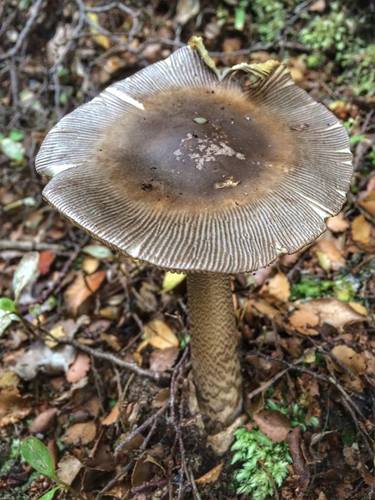
When G.S. Ridley described Amanita pekeoides, he classified it as a “typical member of the Vaginatae” based on its non-bulbous stipe, saccate volva, and inamyloid basidiospores. The pileus (cap) of A. pekeoides measures between 32 and 82 millimetres (1+1⁄2–3 inches) across. It is convex when immature, and gradually becomes plano-convex then plano-depressed as the fruiting body matures. The margin of the pileus is sulcate (grooved); the grooves are greyish sepia, while the central disc and ridges between grooves are hazel to dark greyish sepia, with color paling toward the margin. The pileus is viscid (sticky) when wet but dries quickly. The lamellae (gills) are crowded and free from attachment to the stipe; they are usually 6–10 mm wide, pale buff to buff, with a complete edge that is brown vinaceous to dark grey sepia, and truncated lamellulae (short gills). The stipe (stem) is typically 7–12 centimetres (3–4+1⁄2 in) high and 7–10 mm in diameter. It is hollow, tapers toward the apex, and has a surface colored white to pale greyish sepia, marked with hazel to greyish sepia striate bands that become finer and more numerous closer to the top of the stipe. A key feature that distinguishes A. pekeoides from many other Amanita species is the absence of an annulus (ring) on the stipe. A. pekeoides has a whitish to pale sepia or pale brown vinaceous volva that measures 30–58 mm, and this structure is often hidden under substrate. The volva is fleshy when young but becomes membranous with age; it is saccate (bag-shaped) and usually bilabiate (two-lipped). Some specimens of A. pekeoides collected only in the Nelson region of the South Island and Te Urewera National Park in the North Island of New Zealand have a distinctly friable (easily crumbled) volva that leaves remnants on the pileus and stipe. It has not yet been determined if this trait indicates a separate population of the species, or if it only appears this way because fewer collections have been made from other areas. There are also some individuals of A. pekeoides that are paler, more whitish in overall color, but are otherwise identical to other specimens of the species. A. pekeoides is distributed across the North and South Islands of New Zealand, and grows primarily in association with Nothofagus tree species.