About Amanita pantherina (DC.) Krombh.
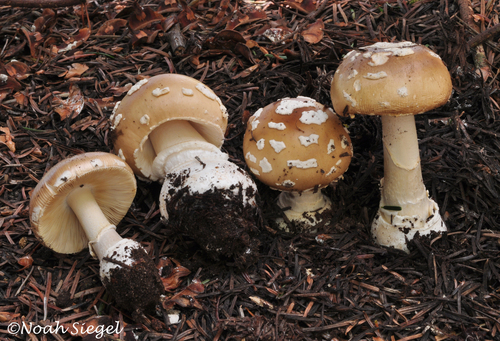
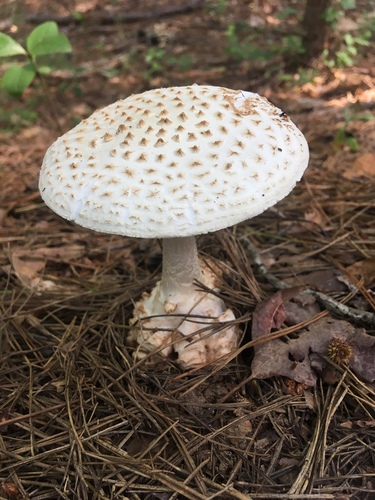
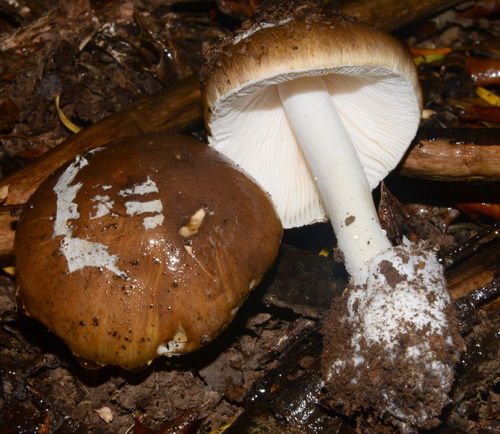
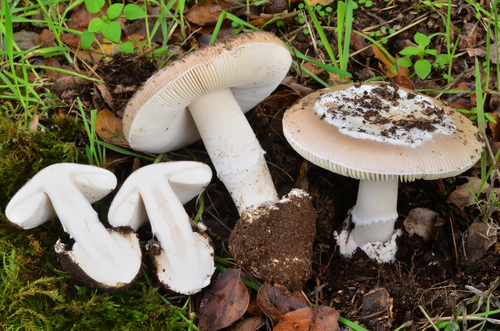
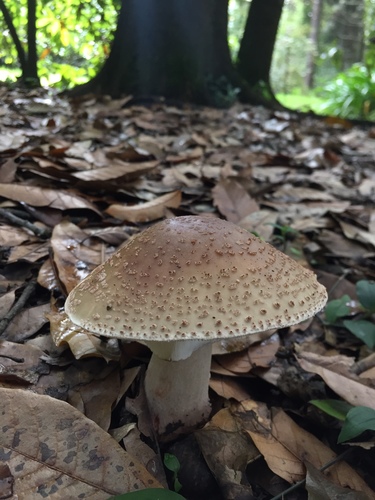
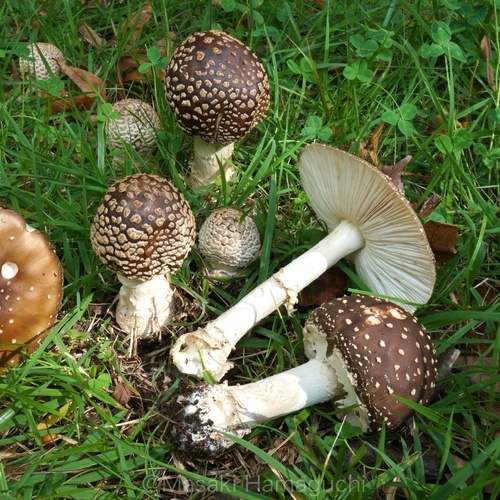
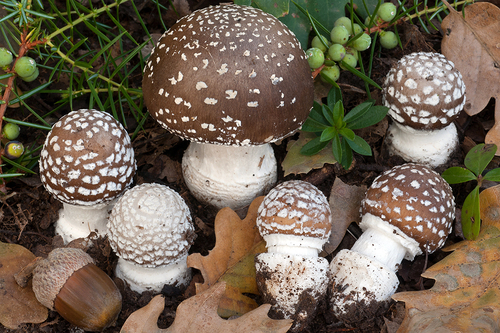
Amanita pantherina (DC.) Krombh., commonly called the panther cap, has a cap that is 5–18 centimetres (2–7 inches) wide. It starts hemispheric, then becomes convex to plano-convex, and ranges in colour from deep brown to hazel-brown to pale ochraceous brown. The cap is covered in densely distributed, pure white to dirty cream warts that are minutely warty, floccose, and easily removable. The cap surface is viscid when wet and has a short striate margin. The mushroom’s flesh is white, and does not change colour when injured. The gills are adnexed to free, close to crowded, start white and become greyish with age, and are truncate. Spore deposits are white; the individual spores are smooth, broadly ellipsoid to ellipsoid to elongate, inamyloid, and rarely globose, measuring 8–14 by 6–10 μm. The stipe is 5–15 cm long and 0.6–3 cm wide, subcylindric, and somewhat narrower toward the top. It is white, turning slightly tannish as it ages, stuffed when young and hollow at maturity. It is finely floccose above the ring, becoming smooth with age, and has small appressed scales or creamy floccose material below the ring. The volva is white, turning grey with age, and forms one or sometimes two narrow hoop-like rings just above the bulbous stipe base. The mushroom’s odour is either unpleasant or similar to raw potatoes. The panther cap is an uncommon mushroom that grows in deciduous woodland (especially beech), less often in coniferous woodland, and rarely in meadows. It is found throughout Europe and western Asia, fruiting in late summer and autumn. It has also been recorded in South Africa, where it is thought to have been accidentally introduced alongside trees imported from Europe and Asia. It is an ectomycorrhizal fungus that forms a root symbiosis with trees: it obtains photosynthetically produced nutrients from its host tree, and provides the tree with soil nutrients in exchange. Amanita pantherina is toxic, more toxic than Amanita muscaria. Consumption can cause diarrhea, vomiting, and hyperhidrosis, which may lead to severe dehydration. Its varieties multisquamosa and velatipes are also considered poisonous. Amanita pantherina contains the psychoactive compounds ibotenic acid and muscimol. These compounds can cause effects including hallucinations, synaesthesia, euphoria, dysphoria, and retrograde amnesia. The effects of muscimol and ibotenic acid most closely resemble the effects of a Z-drug such as Ambien at high doses, and not that of a classical psychedelic like psilocybin. The panther cap is used as an entheogen much less often than its more easily distinguishable relative Amanita muscaria, largely because it is harder to recognize and far more potent. Amanita muscaria contains a higher concentration of ibotenic acid than the panther cap. Most ibotenic acid consumed is broken down by the body into muscimol; residual ibotenic acid is thought to cause most of the dysphoric effects that occur after consuming psychoactive Amanita species. Ibotenic acid is also a scientifically important neurotoxin used in laboratory research as a brain-lesioning agent in mice. As with other wild-growing mushrooms, the ratio of ibotenic acid to muscimol depends on many external factors including season, mushroom age, and habitat, so concentrations vary naturally between individual mushrooms. Dark brown specimens of Amanita pantherina have a higher concentration of ibotenic acid.