About Amanita onusta (Howe) Sacc., 1891
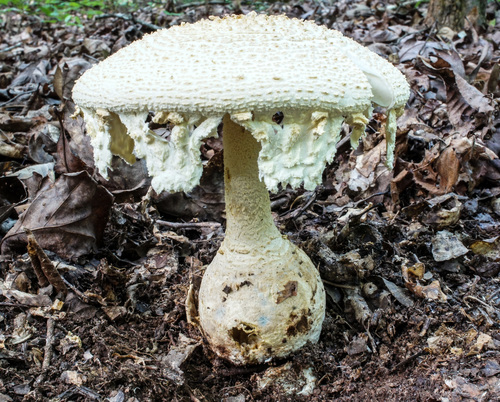
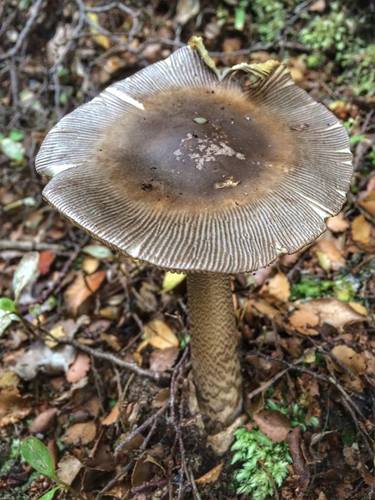
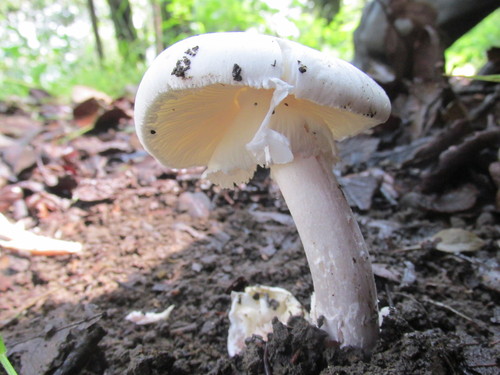
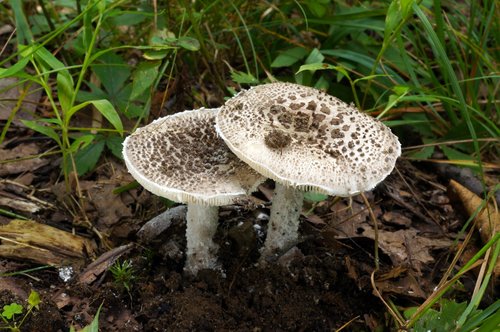
The fruit bodies of Amanita onusta have caps that start out broadly convex and flatten as they mature, reaching 5 to 10 centimetres (2 to 4 inches) in diameter. The grayish-white cap surface is decorated with either conical or pyramidal raised warts, or flattened, symmetrically arranged small gray to brownish gray, grayish brown, or grayish-orange scales called squamules, which are densely packed across most of the surface. Squamules are less crowded near the cap margin, which has no striations and is usually fringed with veil remnants. On the underside of the cap, the gills are closely spaced, either free or narrowly attached to the stipe, and are white to cream in color. Shorter gills that do not reach all the way from the cap margin to the stipe, called lamellulae, are interspersed between full-length gills, and the gills can sometimes look waterlogged. The stipe is 5.5 to 12 cm (2 to 4+1⁄2 in) long, 0.6 to 1.5 cm (1⁄4 to 1⁄2 in) thick, tapers slightly upward, and is solid gray to brownish-gray near its base, turning paler toward the top. It has a cottony (floccose) or hairy (fibrillose) texture. The bulb at the base of the stipe is roughly spindle- to turnip-shaped, and may root deep into the soil, especially if the soil is loose. The short-lived partial veil is white, attached just below the top of the stipe, and is sticky. When the mushroom matures, the partial veil often clings to the upper section of the stipe, or may leave a few small remnants hanging from the cap margin. Universal veil remnants form rows of warts and patches of gray to brownish-gray small scales on the upper part of the basal bulb; the area below these remnants is dirty white. The flesh is firm and white. Fruit bodies have an odor that ranges from mild to slightly unpleasant, described as resembling chloride of lime, the same smell found in some bleach-containing bathroom disinfectants. For microscopic characteristics, spore prints made from Amanita onusta spores are white. When viewed under a microscope, individual spores are broadly ellipsoid to elongate, translucent, thin-walled, amyloid, and measure 8.3–11.6 by 4.9–6.6 μm. The spore-bearing cells, called basidia, are 38–46 by 9–11 μm, club-shaped, mostly 4-spored (some are 2- or 3-spored), and have clamps. Cheilocystidia, which are cystidia located on the gill edge, measure 23.3–31.5 by 11.6–15.7 μm, and are ellipsoid, club- or pear-shaped cells that are partly arranged in short rows. The cap cuticle is up to 168 μm thick, made of thin-walled interwoven hyphae 2–5.3 μm in diameter, and is gelatinized. Clamp connections, short branches that connect one hyphal cell to the previous cell to allow passage of products of nuclear division, are present in the species' hyphae. In terms of distribution and habitat, A. onusta grows alone or scattered on the ground in mixed forests of oak, hickory, and chestnut, ranging from southern New England to Texas. It prefers sandy or loose soils, and its range extends north to Nova Scotia, Canada, and south to Mexico. The edibility of A. onusta is unknown, but it has been classified as possibly poisonous and inedible. Because the Amanita genus contains many toxic species, consumption of any Amanita species is generally not recommended.