About Amanita ocreata Peck
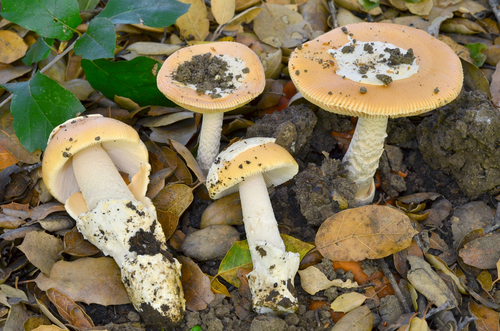
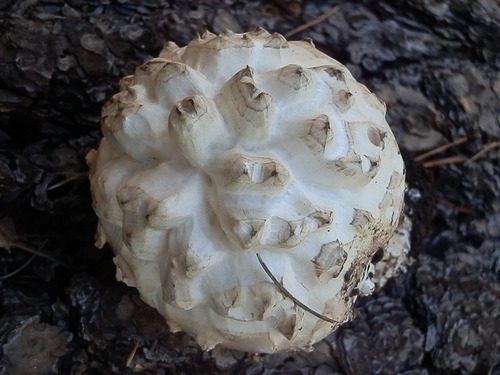
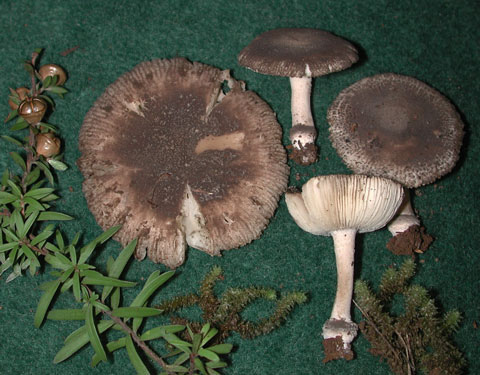
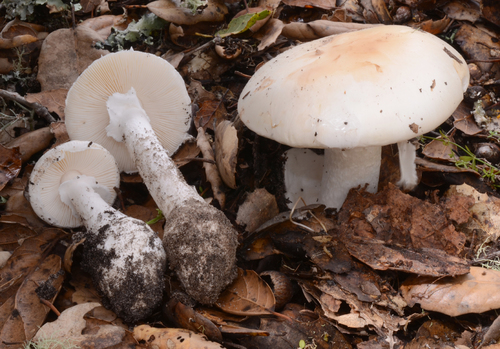
Amanita ocreata is generally stouter than other fungi called destroying angels. It first emerges as a white, egg-shaped structure covered by a universal veil. As it grows, the mushroom breaks free of the veil, though ragged patches of veil may rarely remain on the cap edges. The cap starts hemispherical, then becomes more convex and eventually flattens, sometimes irregularly. This irregular growth can create undulations on the cap surface; mature caps measure 5–15 centimetres (2–6 inches) in diameter. Cap colour ranges from white, through yellowish-white to ochre shades, and often has a brownish centre. Occasionally, parts of the fruiting bodies may have pinkish tones. All parts of the fungus below the cap are white. The crowded gills are adnate to adnexed, and sometimes become fully free from the stipe. The stipe is 6–20 cm (2+1⁄2–8 in) tall and about 1–3 cm (1⁄2–1+1⁄4 in) thick, and it bears a thin white membranous ring that persists until the mushroom reaches old age. The volva is thin, smooth, and sac-like, and may be quite extensive, enclosing almost half of the stipe. The spore print is white. Under a microscope, the spores are subglobose to ovoid to subellipsoid, amyloid, and measure 9–14 x 7–10 μm. Most specimens have no noticeable scent, though some fruiting bodies may carry a faint odour described as bleach or chlorine, dead fish, or iodine. Like other destroying angels, the flesh stains yellow when treated with potassium hydroxide. Amanita ocreata appears from January to April, which is later in the year than most other amanitas, with the exception of A. calyptroderma. It grows in mixed woodland on the Pacific coast of North America, ranging from Washington south through California to Baja California, Mexico. It could potentially occur on Vancouver Island in British Columbia, but this has never been confirmed. The species forms ectomycorrhizal relationships, and is found growing in association with coast live oak (Quercus agrifolia) and hazel (Corylus spp.). In Oregon and Washington, it may also associate with Garry oak (Quercus garryana). Amanita ocreata is highly toxic, and has caused many mushroom poisonings in western North America, particularly in the spring. It contains highly toxic amatoxins and phallotoxins, a trait it shares with the closely related death cap (A. phalloides), other destroying angel species; half a death cap cap can be enough to kill a human. Some evidence suggests it may be the most toxic of all North American phalloideae: a higher proportion of people who consume this fungus develop organ damage, and 40% of those poisoned die. Dogs in California have also been known to consume this fungus with fatal results. Amatoxins are made up of at least eight structurally similar compounds, all featuring eight amino-acid rings. Of the amatoxins found in A. ocreata, α-Amanitin is the most common, and along with β-Amanitin it is likely responsible for the toxin's harmful effects. The main toxic mechanism is inhibition of RNA polymerase II, an essential enzyme for synthesizing messenger RNA (mRNA), microRNA, and small nuclear RNA (snRNA). Without mRNA, essential protein synthesis stops, halting cell metabolism and causing cell death. The liver is the organ primarily affected, since it is the first organ the toxins reach after gastrointestinal absorption, though other organs especially the kidneys are also susceptible to the toxins. Phallotoxins consist of at least seven compounds, all with seven similar peptide rings. While phallotoxins are highly toxic to liver cells, they have little involvement in A. ocreata's overall toxicity because they are not absorbed through the gut. Additionally, one phallotoxin, phalloidin, is also found in the edible and popular blusher (Amanita rubescens).