About Amanita nothofagi G.Stev.
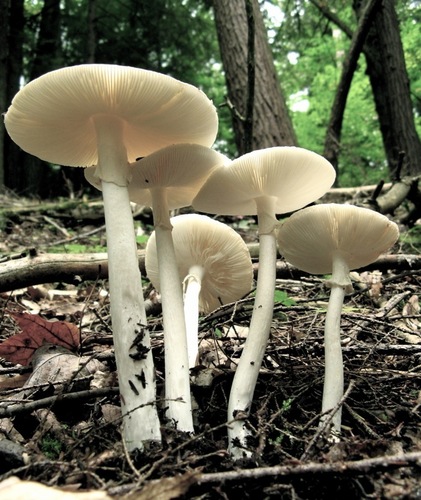
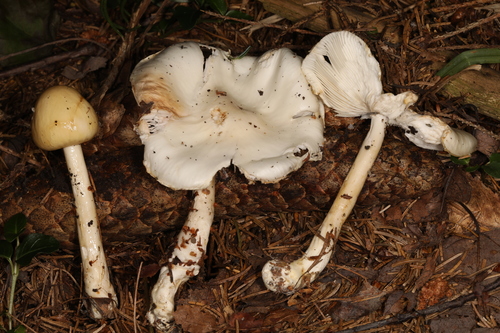
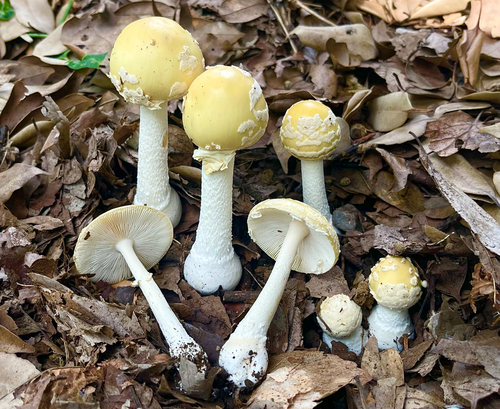
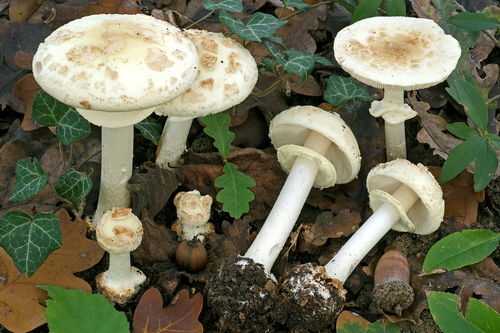
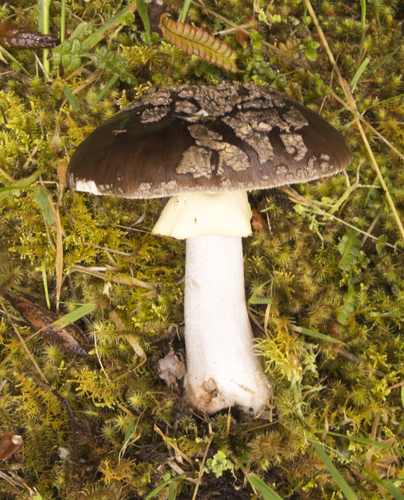
The cap of Amanita nothofagi starts out convex, becoming flattened with a central depression as it matures, with radial grooves along the margin. It reaches 3 to 13 centimetres (1 to 5 inches) in diameter. Cap colour is variable, ranging from buff to dark grey to greyish-sepia, with radial streaks of dusky brownish grey. When young or wet, the cap surface is sticky, and it dries out as the mushroom ages. Remnants of the volva form small to large, irregularly shaped, felted patches. These patches are dull greyish-sepia to sepia, and are sometimes scab-like. The gills are closely crowded, and do not attach to the stem. They are white to cream-coloured, and 6–10 mm (1⁄4–3⁄8 in) wide. Lamellulae, short gills that do not extend fully from the cap margin to the stem, have somewhat truncated ends. The stem measures 4–14 cm (1+5⁄8–5+1⁄2 in) tall and 5–25 mm (1⁄4–1 in) thick, and tapers slightly toward the top. It is hollow, with a bulbous base 10–30 mm (3⁄8–1+1⁄8 in) in diameter. Above the ring, the stem surface is white, sparsely covered with woolly or fuzzy tufts, and occasionally breaks into transverse bands. Below the ring, the stem surface is smooth, or occasionally breaks into bands or fibrillose scales. The stem is whitish, buff, or greyish-sepia streaked with grey. The stem base may or may not have a band and rim of buff to greyish-sepia volval remnants. The ring is membranous, grooved, and coloured whitish, buff, greyish-sepia or lavender-grey. It hangs freely when young, and later sticks to the stem; it often tears and adheres to the edge of the cap. Flesh colour in the cap is white or stained mouse-grey under the central portion, and occasionally has a grey line above the gills. Flesh in the stem is white to pale buff. The spore print is white. Individual spores typically measure 7.5–9 by 7.5–9 μm, and range in shape from spherical to broadly ellipsoid to ellipsoid. They have thin walls. Under a microscope, spores are hyaline (translucent), and amyloid, meaning they turn bluish-black to black when stained with Melzer's reagent. Basidia measure 30.5–57 by 8–16 μm, are four-spored, and do not have clamps at their base. Gill margin cells are plentiful, shaped spherical, club-shaped, or swollen spherically at the tip. They are hyaline, and measure 13–58 by 8–33 μm. The cap cuticle is made of a 130–220 μm wide strongly gelatinised upper layer (suprapellis), and a dense non-gelatinised lower layer (subpellis). The volval remnants on the cap are composed of abundant spherical, elliptic, and club-shaped cells 21–119 by 14.5–115 μm, intermixed with hyphae 4–9 μm wide that are pale umber in colour. These components are arranged either irregularly or in a vertical orientation. Fruit bodies of Amanita nothofagi grow singly or in scattered groups. Like all Amanita mushrooms, it is mycorrhizal, and grows in close association with Southern Beech in the genus Nothofagus, including New Zealand Red Beech, Silver beech, New Zealand Black Beech, and Hard Beech, as well as Manuka and Kanuka. It is found on both the North and South islands of New Zealand, and it is the most common endemic Amanita species in the country.