About Amanita nehuta G.S.Ridl.
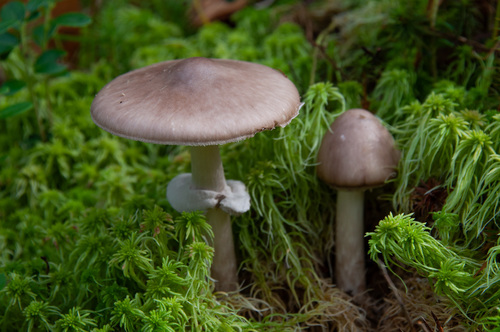
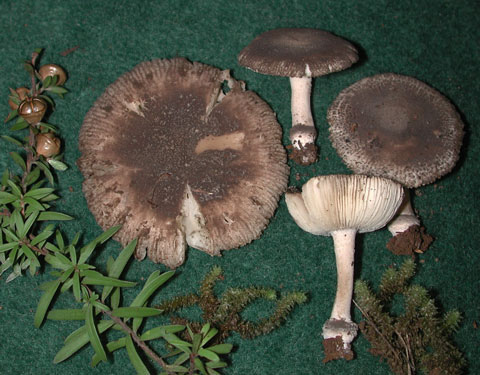
This fungus grows on the ground, typically in late summer. Its cap is 2.5–6.5 centimetres (1–2+1⁄2 inches) wide, with a plano-convex to plano-depressed shape, a buff color, a non-viscid texture, and a striate margin. Volval remnants on the cap center are pulverulent, and are raised into wart-like peaks, warts, or radial ridges, and colored pale sepia. The gills are crowded, free from the stipe, 6–7 millimetres (1⁄4–9⁄32 in) wide, and range from white to pale buff. Short gills of this species are subtruncate. The stipe measures 20–75 × 4–11 mm, is hollow, and has no ring. Its upper section is smooth to subfloccose, while its lower section is smooth. The stipe surface is white, pale buff, or very pale grayish sepia, matching the cap color. The stipe's basal bulb is clavate to bulbous, with a diameter of 10–16 mm. A rim or band of powdery volva matching the cap's volval color appears on the stipe base. Spores measure 6.5–9 × 5.5–8 (-8.5) µm, are subglobose to broadly ellipsoid to ellipsoid, inamyloid, and white. Clamp connections are absent at the bases of the basidia. The flesh is white, with a very pale area under the cap skin at the cap center. This species was first described from a collection from Wellington, New Zealand. It grows in association with many types of Nothofagus, Leptospermum, and Kunzea. It is also confirmed to occur on the South Island of New Zealand.