About Amanita fulva Fr.
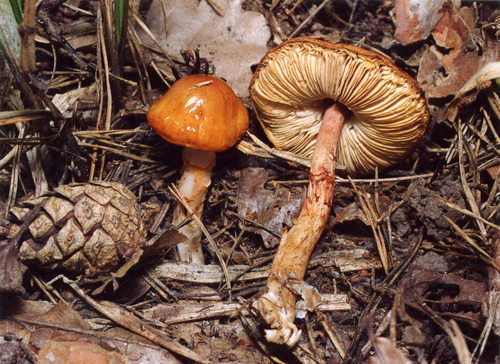
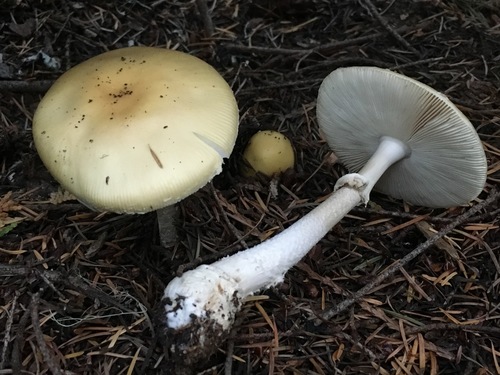
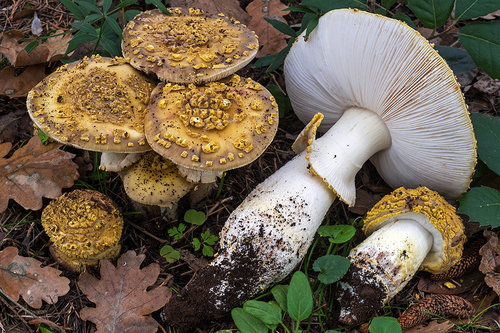
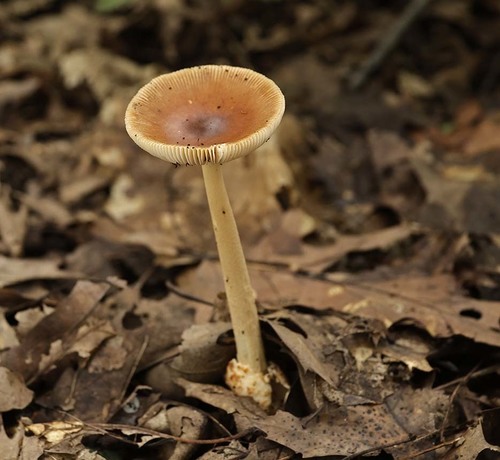
The fungus Amanita fulva Fr. has a fruiting body that is initially entirely enclosed by a membranous universal veil. As it matures, this veil develops into a white, sacklike volva marked with rusty-brown blemishes. Whitish veil remnants only rarely stay attached to the cap. The cap itself is otherwise smooth, with a strongly striated margin. It reaches up to 10 centimetres (4 inches) in diameter, starts convex and becomes flat or umbonate, and ranges in color from orange-brown to reddish-tan. The cap is viscid when moist. The gills are free, closely spaced, and broad. The flesh of the fungus is white to cream. The stem, also called stipe, is white, with a smooth or powdery texture; it may sometimes be tinged with orange-brown and covered in very fine hairs. It is slender, ringless, hollow, and quite fragile, tapering toward the top. It grows up to 15 cm tall and between 1 and 1.5 cm thick. The spores of Amanita fulva are white, globose, and nonamyloid, measuring 9 × 12 μm, with a more detailed size range of (9.0-) 10.0–12.5 (-19.3) x (8.2-) 9.3–12.0 (-15.5) μm. This species is distributed throughout Europe, where it grows in a wide variety of forests, forming mycorrhizal associations with oak, birch, spruce, pine, chestnut, and alder. In Scandinavia, it is often found associated with birch, while collections from southern Europe usually come from oak, chestnut, and pine forests. It grows in acidic soils, and produces fruiting bodies from summer to late autumn, which corresponds to May to November in the United Kingdom. Its abundance ranges from common to scarce, and it is very common in Britain. Amanita fulva is considered to be widely distributed in North America, growing in both deciduous and coniferous forests, though some North American collections labelled as this species may in fact belong to a different, still undescribed species. The name A. fulva has also been incorrectly applied to other North American taxa in the past, such as A. amerifulva and others.