About Amanita flavorubens (Berk. & Mont.) Sacc., 1887
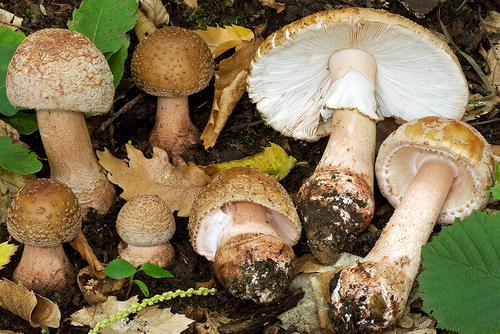
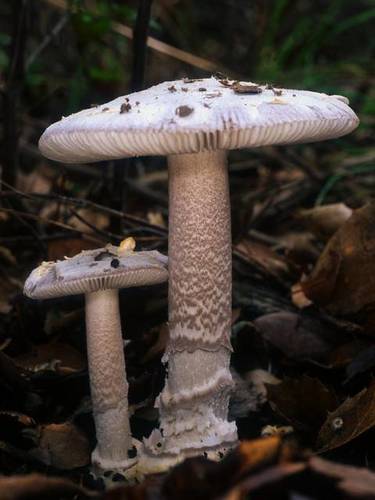
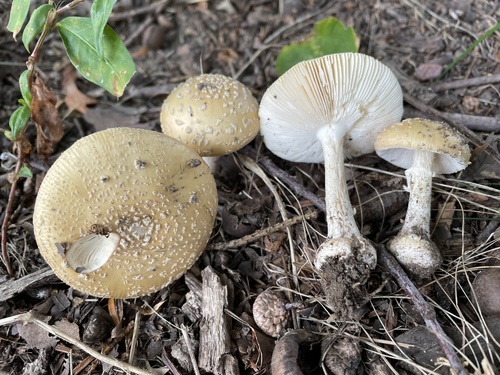
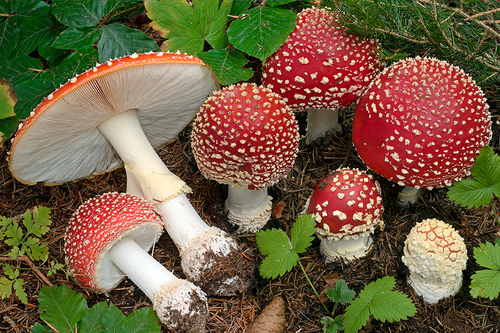
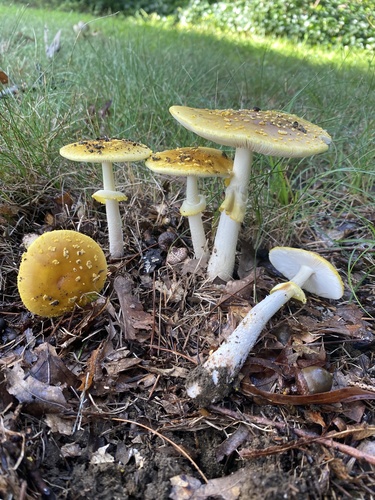
Amanita flavorubens (Berk. & Mont.) Sacc., 1887 has a cap measuring 3.5–10.5 centimetres (1+1⁄2–4 inches) wide. Cap color ranges from yellow, brassy yellow, or lemon yellow, sometimes dark orange brown; rain can wash out all pigment to leave the cap pallid, and bruising during development can turn the entire cap very deep wine red. Cap shape progresses from subovoid to hemispheric, convex, plano-convex, and becomes depressed in the center. The cap surface is slightly tacky, dull, subviscid, or subvelvety, with an incurved or downcurved, rimose, nonstriate margin that may become slightly striate as the mushroom ages. The cap is covered in conspicuous, woolly to felty yellow warts, and is bald underneath these warts; the margin is not lined, or only faintly lined when mature. Remnants of the universal veil (volva) appear as yellow to orange to bright orange-yellow flocculent to confluent warts, which are friable, sparsely and irregularly distributed, easily removable, and pulverulent, with splotchy brown coloring around the cap center and yellow coloring at the cap edge. The cap flesh is 3–7 millimetres (1⁄8–1⁄4 in) thick above the stem, thinning evenly toward the margin; it is white or yellowish, and bright yellow just under the cap skin. The gills are free to very narrowly adnate, subcrowded to crowded, and colored creamy ivory to cream to off-white. They are 3–8 mm broad, with a white pulverulent edge and a small decurrent tooth. Short gills vary in form from truncate, subtruncate, subattenuate, to stepwise attenuate; they are unevenly distributed, variable in length, and plentiful. The stem measures 5.2–15 cm × 0.7–1.4 cm, usually narrowing upward (rarely narrowing downward), and flares at the top. Above the ring, the stem is yellow to white or very pale yellowish white, and pruinose to finely powdery; below the ring, it is white to yellow, or occasionally has scattered yellowish surface fibrils and is fibrillose, sometimes with silky longitudinal striations. The stem bulb is 15–25 × 15–21 mm, more or less turnip-shaped, with light red-pinkish stains; intense wine-red staining most often appears first in the interior of the bulb. The ring is membranous, superior, skirt-shaped, flares out then collapses, and is pale yellowish white to cream to white, with a slightly more yellow underside and a thickened edge. Volva remnants are either absent, or present as rings of yellow-brown warts on the bulb, or as large, friable, detersile brilliant yellow loose patches appressed to the stem, which are sometimes lost during specimen collection. Stem flesh is white or slightly pink, and can be hollow, partially hollowed, or stuffed in the center. Spores measure 7.8–11 × 5.4–7 μm, are ellipsoid to elongate (rarely broadly ellipsoid), and amyloid. Clamp connections are not present at the bases of basidia. Rain quickly washes pigment away from the yellow-orange cap. While bruising is sometimes only reported at the stem base for this species, it commonly occurs across the entire fruiting body. Occasionally, especially in areas with dense root mats, specimens can be found with an entirely wine-colored cap from bruising during expansion through the root mat. One researcher has documented a specimen that was intensely bruised before cap expansion; this specimen had a dark red brown cap center, with brown to pale yellow brown color toward the cap margin, and cap warts arranged in concentric rings that were roughly matching the color of the surrounding cap skin, but always retained a distinct yellow tint. The odor of this species is described as that of clean laundry. A. flavorubens was originally described from the U.S. state of Ohio. It is currently known from forests associated with beech (Fagus grandifolia), oak (Quercus), pine (Pinus), birch (Betula), and Canadian hemlock (Tsuga canadensis). Its range extends from southeastern Canada to the state of Alabama in eastern North America, and also occurs in central Mexico and southeastern Arizona. A. flavorubens is one of the few North American taxa known to have a western population disjunct from its main eastern distribution area.