About Amanita echinocephala (Vittad.) Quél.
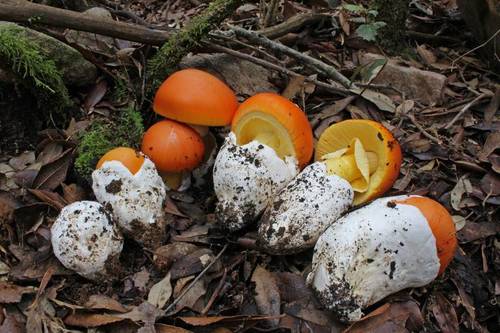
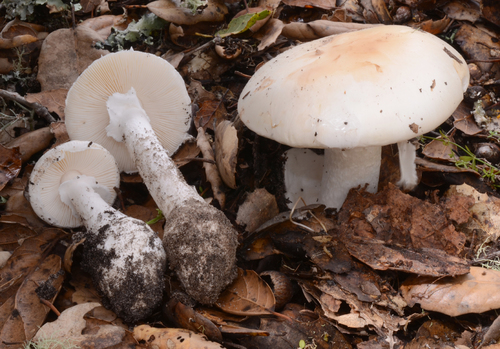
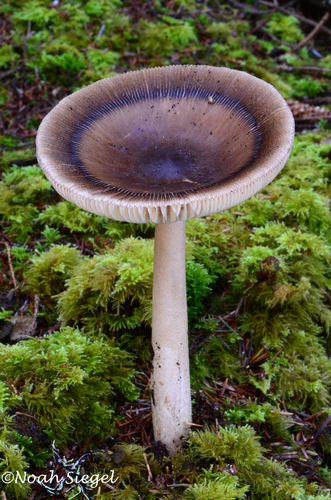
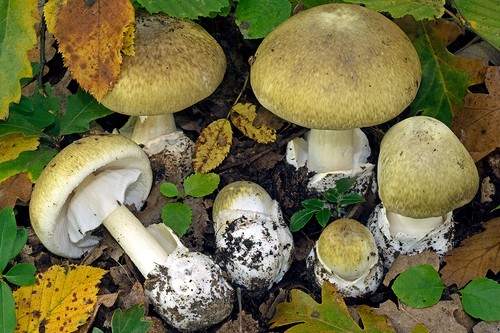
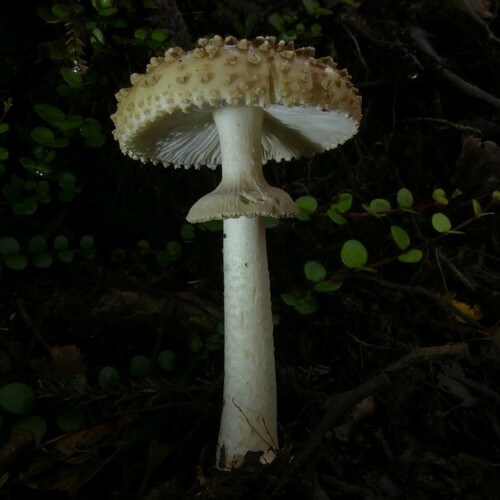
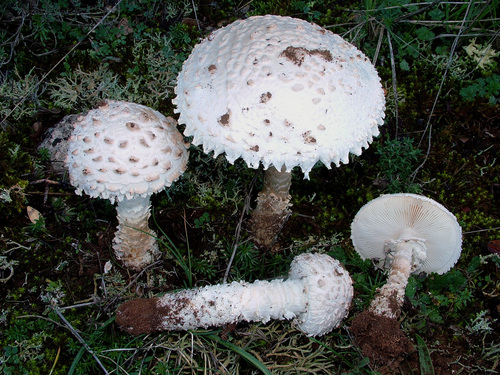
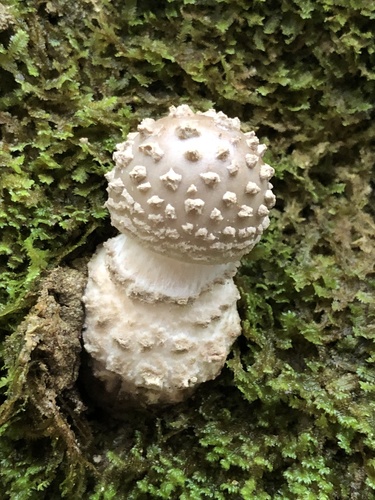
Amanita echinocephala (Vittad.) Quél. has a cap that can reach up to 15 centimetres (6 inches) in diameter, and ranges in colour from white to ivory or silver-grey. The cap surface is covered in raised pyramidal warts, which become less well-defined and less frequent closer to the cap margin. These warts are remnants of the universal veil that covers the mushroom during its earliest growth stages. Young button-stage specimens of this species are darker, and sometimes shaped like a two-tier loaf, with a ring of raised scales around the base. The stipe is white to ivory, measuring 8–16 cm (3–6+1⁄2 in) in height and 2–3 cm (3⁄4–1+1⁄4 in) in width. It features several rings of upturned scales near its bulbous base. The stipe grows fairly deeply rooted, often extending laterally below the soil surface. The partial veil ring is thin and fragile, and often adheres to the stipe. The gills are cream-coloured, sometimes with a faint green tint. They are mostly free from the stipe, though they sometimes have a small decurrent tooth. The flesh is white, and is reported to have an unpleasant smell. A. echinocephala is distributed across Britain, Europe, Western Asia, and North Africa. In Britain, it appears during summer and early autumn. It grows in light, dry calcareous soils in association with both broad-leaved trees (usually beech, Fagus) and coniferous trees. It is quite drought-tolerant, leading to the suggestion that Southern England may mark the northern extent of its range. In the Czech Republic, it occurs with hardwoods on calcareous soils, and is often associated with limes (Tilia), sometimes growing alongside A. strobiliformis.