About Amanita daucipes (Sacc.) Lloyd
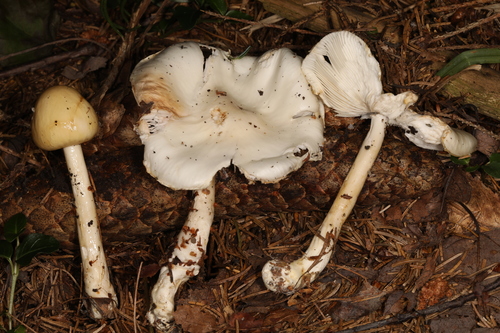
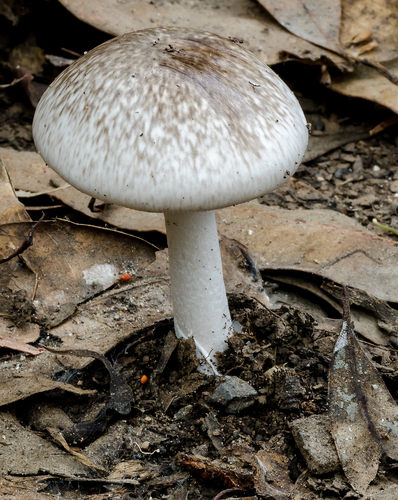
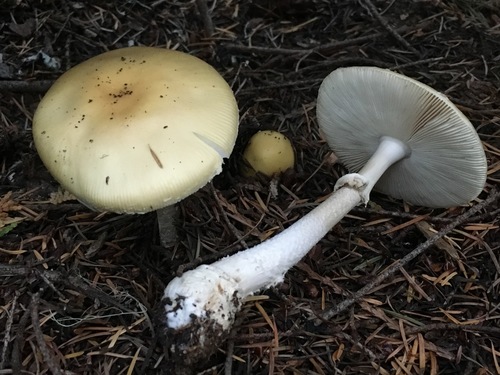
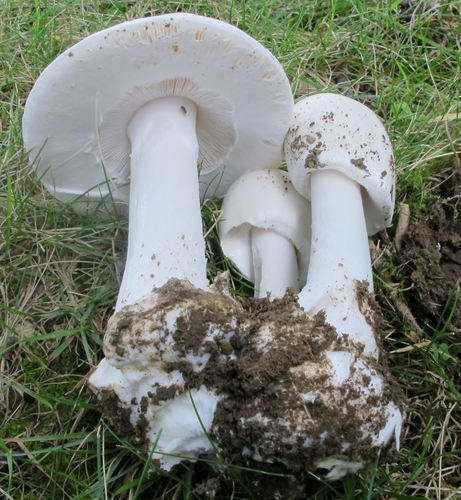
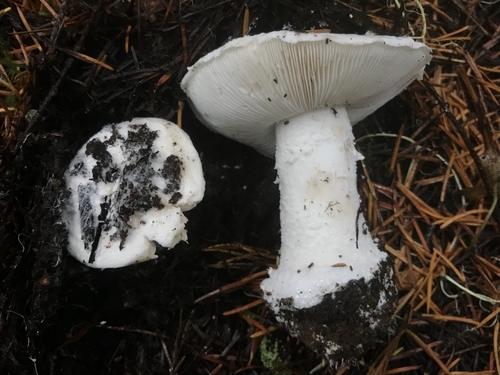
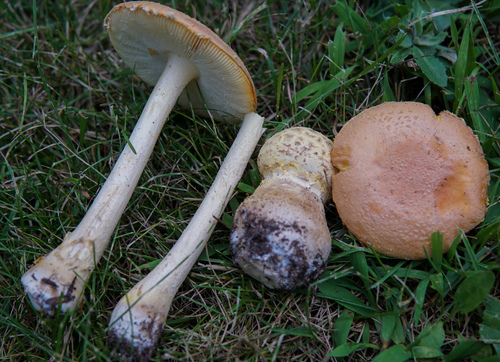
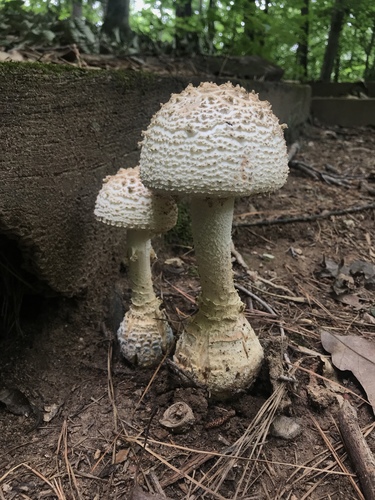
The fruit bodies of Amanita daucipes have caps that start convex and flatten at maturity, with a diameter ranging from 6 to 25 centimeters (2+1⁄2 to 10 inches). The cap surface is dry to shiny, white with a pale orange hue, and densely covered in randomly distributed white to pale orange or reddish-brown conical warts. These warts are remnants of the universal veil, and become fluffier and cotton-like (flocculent) near the cap margin. Drier specimens may have the cap surface fully cracked around the base of each wart. The conical warts are detersile, meaning they can be easily removed from the cap surface without leaving residue or a scar. The cap margin has no striations, and like other members of Lepidella, may have irregular veil remnants hanging from it. The gills are free, closely crowded, moderately narrow, and white to yellowish white. Short gills that do not reach fully from the stem to the cap margin, called lamellulae, are rounded to gradually narrowing (attenuate) and come in varying lengths. The stem is 7.5 to 20 cm (3 to 8 in) long, 0.8 to 2.5 cm (1⁄2 to 1 in) thick, attached to the center of the cap. It tapers slightly toward the apex, is solid, dry, white or sometimes pale orange-tinted, and covered in tufts of soft woolly hairs. When handled, the stem slowly bruises and discolours to roughly the same colour as the cap. The basal bulb is large, growing up to 15 by 12 cm (6 by 4+1⁄2 in), and is broadly spindle- to turnip-shaped. The upper part of the bulb has a circular ridge from the former attachment of the universal veil, and the bulb may develop longitudinal splits. It is covered in pinkish to reddish veil remains. The partial veil forms an ephemeral ring on the upper stem, which is white to pale yellow, and usually falls off as the cap expands; ring fragments can often be found on the ground near the stem base. Any present universal veil remnants match those found on the cap. The flesh is firm and white. Fruit bodies have a strong, unpleasant odour described as "sweet and nauseous"; it has also been compared to "an old ham bone or soap" or "decaying protein", particularly in older specimens. For microscopic characteristics, spore prints of A. daucipes spores appear white, cream, or yellowish when viewed in deposit. Under a microscope, spores are ellipsoid to elongate (sometimes kidney-shaped/reniform), measuring 8–11 by 5–7 μm. They are translucent (hyaline), thin-walled, and amyloid, meaning they absorb iodine when stained with Melzer's reagent. The spore-bearing basidia are 30–50 by 7–11 μm, club-shaped, 4-spored, and have clamps at their bases. Cheilocystidia are abundant, small, and roughly spherical to club-shaped, measuring 15–40 by 10–28 μm. The cap cuticle is 75 to 180 μm thick, made of a dense layer of thin-walled, interwoven, slightly gelatinized hyphae 2–5 μm in diameter. Clamp connections are present in this species' hyphae. A. daucipes is a mycorrhizal species; its fruit bodies grow solitary or scattered on the ground in mixed coniferous and deciduous forests, especially oak-dominated forests, across Maryland, North Carolina, New Jersey, Ohio, Pennsylvania, Tennessee, Virginia, West Virginia, Kentucky, and Texas. Additional associated tree species include hickory (genus Carya) and birch (Betula). The species is noted to prefer disturbed soil, such as that found along roadsides. Amanita expert Cornelis Bas, writing in his 1969 comprehensive monograph on the genus, called A. daucipes a rare species; later research found it to be common in oak forests of the eastern United States. The southern end of its distribution reaches Sonora, Mexico. The edibility of A. daucipes is unknown, but consumption is not recommended because several poisonous species are also in the Lepidella section of the Amanita genus.