About Amanita cokeri E.-J.Gilbert & Kühner ex E.-J.Gilbert
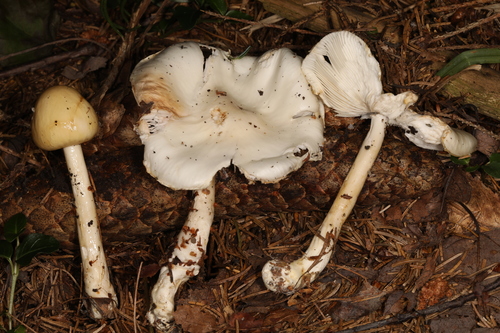
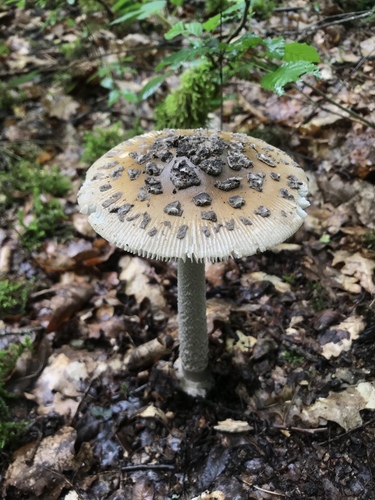
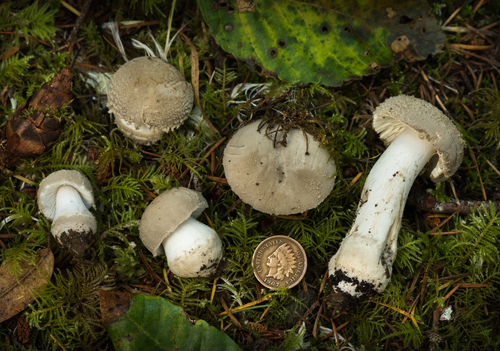
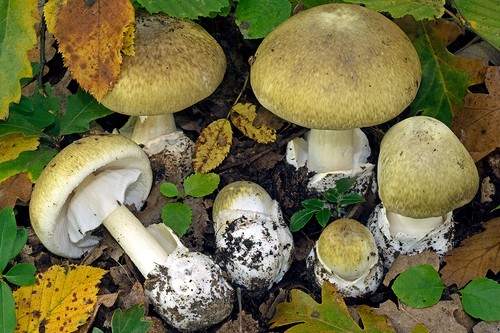
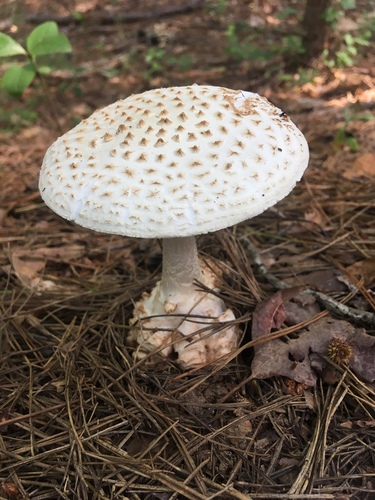
The cap of Amanita cokeri is white, 7–15 centimetres (3–6 inches) across, and ranges in shape from oval to convex. Its surface is dry, but becomes sticky when wet, and marked by large pointed warts that are white to brown in color. The gills are closely spaced, free from the stem, cream-colored when young and turning white as the mushroom matures. Short gills occur frequently on this species. The stem is white, measuring 10–20 cm (4–8 in) long and 1–2 cm (1⁄2–3⁄4 in) thick. It tapers slightly toward the top, and has a texture ranging from smooth to shaggy. A thick, often double-edged ring is present on the stem, with a tissue-like underside. Remnants of the universal veil hang from the top of the stipe. The basal bulb is quite large, marked with concentric circles of down-turned scales, and has irregular patches of adhering volval remnants. Spores are white, elliptical, amyloid, smooth, and measure 11–14 x 6–9 μm. The flesh is white and does not change color when exposed to air. There is no characteristic odor, though some specimens may develop a scent resembling decaying protein. Amanita cokeri grows on the ground in mixed coniferous or deciduous woodlands, most commonly associated with oak and pine trees, and leaves a white deposit. It may grow either isolated or in groups, and is distributed mainly in southeastern North America. Its fruiting season runs from July to November. One study detected two unusual non-protein amino acids in this species: 2-amino-3-cyclopropylbutanoic acid and 2-amino-5-chloro-4-pentenoic acid. The first amino acid was found to be toxic to the fungus Cercospora kikuchii, the arthropod Oncopeltus fasciatus, and the bacteria Agrobacterium tumefaciens, Erwinia amylovora, and Xanthomonas campestris. This toxic effect on bacteria could be removed by adding isoleucine to the growth medium. The second detected amino acid showed no toxicity in testing.