About Amanita ceciliae (Berk. & Broome) Bas
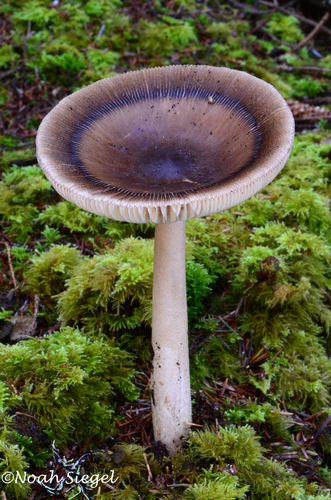
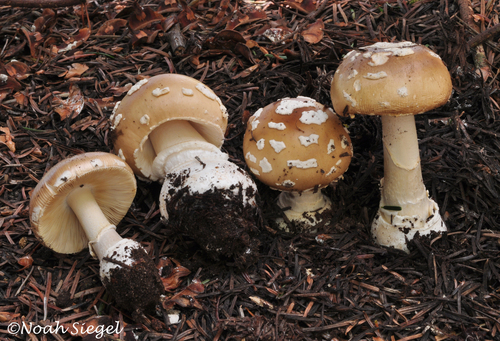
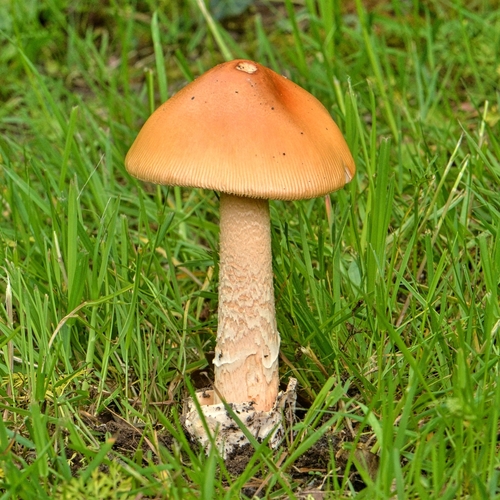
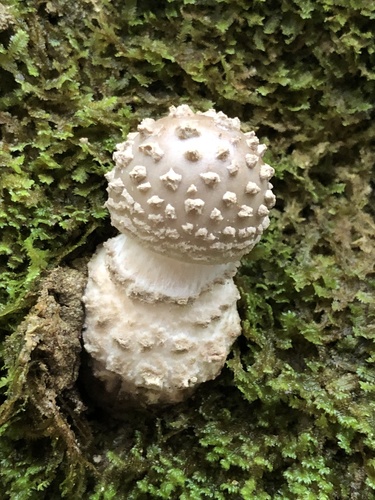
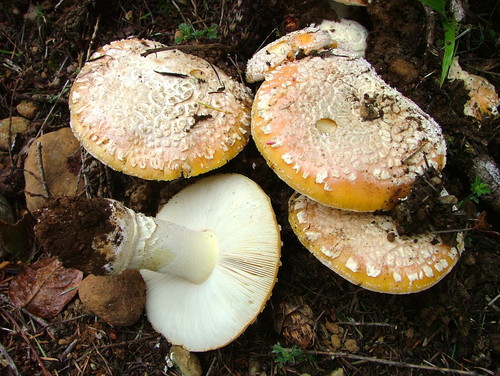
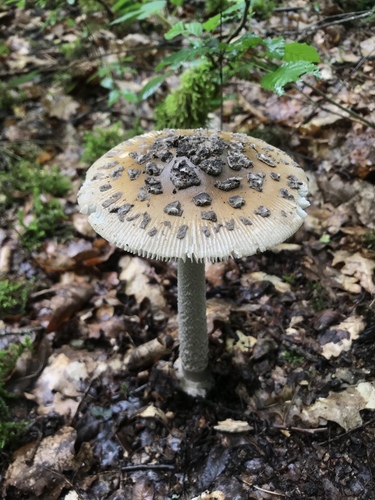
Amanita ceciliae produces large fruit bodies, with caps that measure 5–12 cm (2.0–4.7 in) across. Caps start convex and flatten out over time, are slightly upturned, have a low umbo, a deep-colored, strongly striated margin, and are grey to brownish-black, darkest at the center and paler toward the edge. The cap surface is generally smooth, slightly sticky when moist, and scattered with loose, fleecy, easily removable charcoal-grey patches of volval remnants. Cap color can vary: pale forms exist, including the variants A. c. f. decolora and A. c. var. pallida, while A. c. var. royeri, a cinder black-capped variant first described by mycologist L. Maire in 2008, is found in France. Gills are free, closely spaced, white, thick, and often forked. The stipe (stem) is 7–18 cm (2.8–7.1 in) long, 120–200 mm (4.7–7.9 in) by 20–40 mm (0.79–1.57 in) thick, slightly tapered toward the top, white with flat grey zig-zag patterned hairs. It starts lightly filled with cottony tissue, becomes hollow, does not have a ring, and has fragile, cottony, brownish or charcoal-colored oblique bands of volval remnants around the base and lower stem. The universal veil is white to grey, powdery and delicate. The flesh is white and does not change color when cut; it has no distinctive odor and a sweet taste. Spores are white, spherical, non-amyloid, and measure 10.2–11.7 micrometres. A few large spores are commonly found in gill tissue mounts, and clamp connections are not present at the bases of basidia. In Europe, Amanita ceciliae is widespread across the continent, though it is not often encountered. It most often grows in deciduous forests with Carpinus (hornbeam), Quercus (oak), Fagus (beech) and Betula (birch), and rarely occurs with conifers including Pinus (pine), Abies (fir), Picea (spruce) and Cedrus (cedar). It prefers neutral to calcareous soils. In North America, it is found mainly east of the Mississippi River, with similar populations also occurring in the Pacific Northwest, the Southwest, and Texas, and its range extends south into Mexico. This species is mycorrhizal, growing in both hardwood and coniferous forests, appearing solitary, scattered, or in groups during summer and autumn. In Texas, it has an apparent association with pecan trees.