About Amanita caesarea (Scop.) Pers.
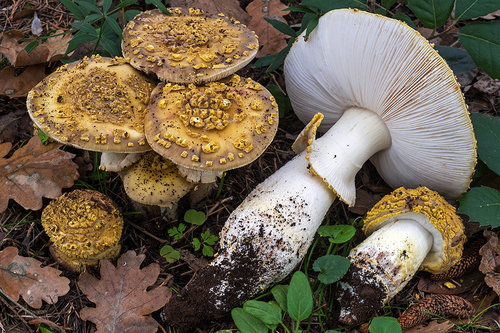
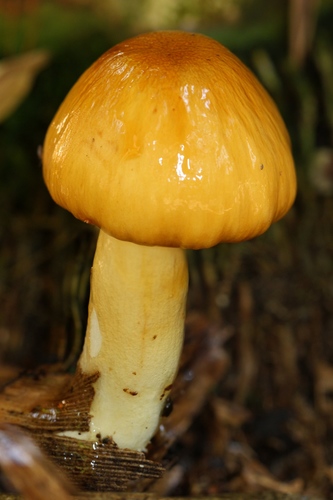
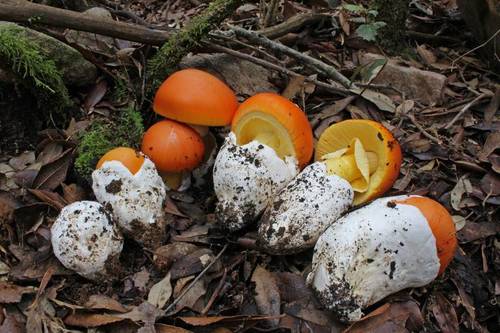
This species, Amanita caesarea (Scop.) Pers., is a mushroom with an orange to red cap that starts out hemispherical, becomes convex, and finally flattens out, reaching up to 20 centimetres (8 inches) in diameter. The cap surface is smooth, with striated margins. Its gills are adnexed or free, closely spaced, and yellowish. The stipe, which is similar in color to the cap or slightly paler, grows 5–15 cm (2–6 in) tall and 1.5–3 cm (1⁄2–1+1⁄4 in) wide. The ring hangs loosely from the stipe and is often striate. The base of the stipe is either equal or bulged, and sits within a white, cup-like volva that is a remnant of the mushroom's universal veil. The mushroom's spores are white, and it produces a white to faintly yellow spore print.
In terms of distribution and habitat, Amanita caesarea is found in North Africa and southern Europe, particularly in the hills of northern Italy. It is thought to have been introduced north of the Alps by Roman armies, as it is most often found along old Roman roads. It also occurs in the Balkans and Hungary, and may be present in Iran; however, Iran is not well explored mycologically, so undescribed species may have been mistakenly identified as this taxon. In Europe, Amanita caesarea grows primarily in oak and pine forests. It grows individually or in groups from early summer to mid autumn. In warmer climates, this mushroom fruits in higher elevation oak woodlands, sometimes mixed with conifers.
For uses, Amanita caesarea is a highly valued edible mushroom in Europe. It is traditionally gathered and consumed in Italy, where it is called ovolo, ovolo buono, or "fungo reale". It has also been a traditional food in Mexico, where it is eaten roasted with a small amount of the herb epazote, Dysphania ambrosioides. An international export market for the mushroom developed in the 1990s. It is also widely eaten in the Himalayas and Tibetan areas.