About Amanita basii Guzmán & Ram.-Guill.
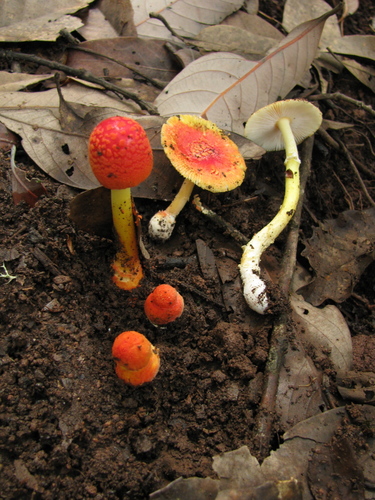
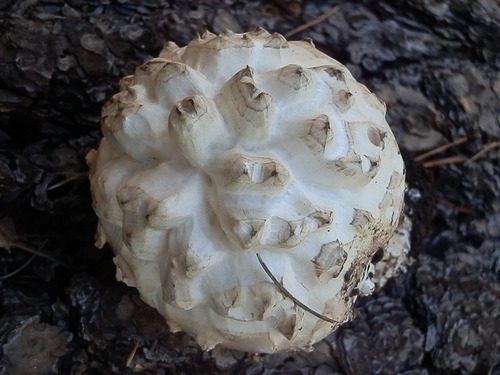
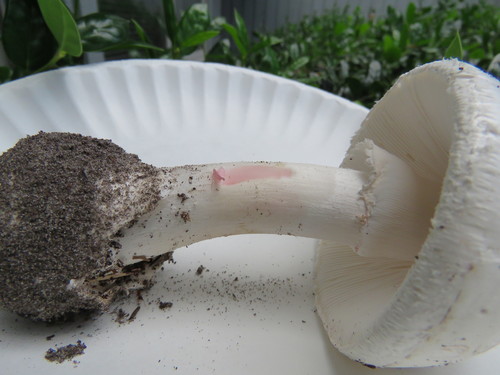
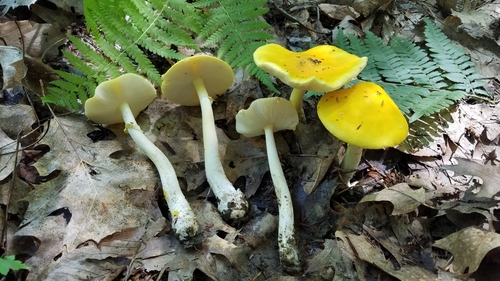
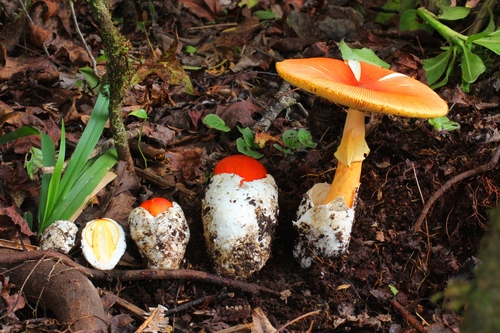
Amanita basii Guzmán & Ram.-Guill. has a cap 67–152 millimetres (2+1⁄2–6 inches) wide. The cap color ranges from brownish red to cadmium orange, becoming very intense red, lake red, or brownish red at the center, which is somewhat faded by sun exposure. The cap margin is red-orange, orange-yellow to deep orange in spots, and turns yellow at maturity. A volva is absent from the cap at maturity, though young specimens may have small white volva patches. The flesh under the cap cuticle ranges from butter yellow to yellowish, and is yellow in the center and near the cap margin; elsewhere it is pale yellowish white to white. The flesh is 9–13 mm (1⁄4–1⁄2 in) thick above the stem, and thins evenly toward the cap margin. The gills are free, subcrowded, thickest close to the margin, and 9–12 mm broad. The stem measures 124–137 mm (5–5+1⁄2 in, or 12.4–13.7 cm) long by 16–23 mm (1.6–2.3 cm) wide. It is subcylindric to cylindrical, stuffed with moderately dense material, and has a light yellow base color that becomes pale yellowish to orange in the upper stem; it turns brown to blackish when handled. The stem surface has irregular ragged patches and strands of orange-yellow felted to membranous material, which become more intensely orange when handled. The ring is subapical (attached in the upper stem), skirt-like, copious, membranous, and persistent; it is orange-yellow when young, becoming yellow-orange. The saccate volva is smooth, dry, membranous, firmly attached to the stem, and white with yellow tints on the inner surface. The stem flesh is white, staining light yellow, and is stuffed with moderately dense material. Spores measure approximately 9.0–11.8 (range 8.0–18.0) × 6.1–7.5 (range 5.5–9.0) μm. They are broadly ellipsoid to elongate, rarely cylindric, and inamyloid. Clamp connections are common at the bases of basidia. This species occurs in pine forests in Mexico. It is considered edible, with a sweet taste and a somewhat pleasantly fungoid odor, though it is less well known than other edible mushroom species. In Guatemala, Amanita basii is commonly sold in local markets near the Mexico border, alongside other mushrooms usually from the Russulaceae family (which includes russulas and milkcaps). It is also a common culinary mushroom in parts of Mexico where huitlacoche is also commonly consumed.