About Amanita augusta Bojantchev & R.M.Davis
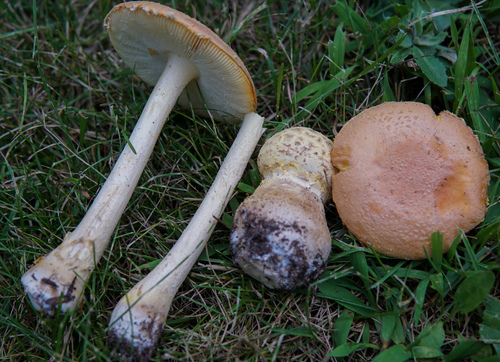
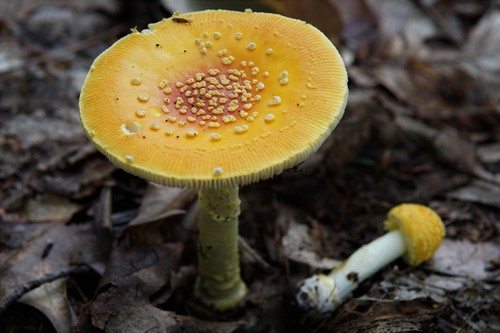
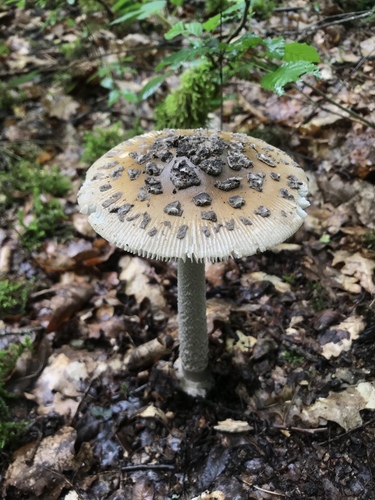
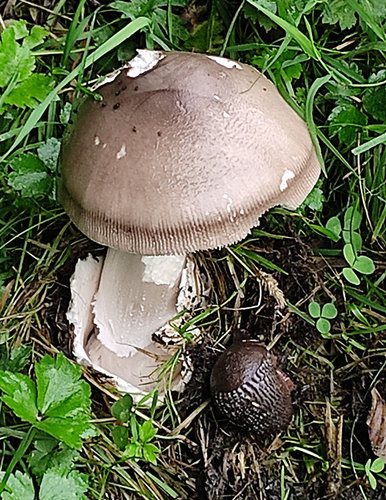
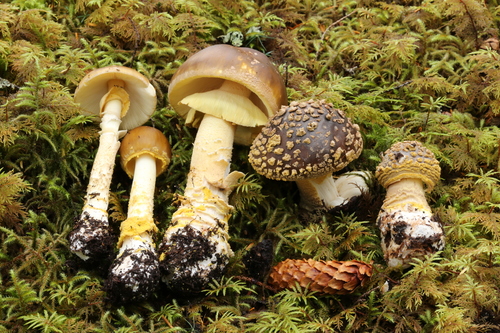
Amanita augusta Bojantchev & R.M.Davis has a cap 4–12 centimetres (1+1⁄2–4+1⁄2 inches) across, with a plano-convex shape. The cap surface is smooth, colored in various shades of brown, and dotted with scattered yellow to brown warts that are remains of the universal veil. The mushroom's flesh is soft, and ranges from white to light yellow in color. It has close, white gills (lamellae) that are either free from the stipe or mildly attached to the upper portion of the stipe. The stipe measures 5–15 cm long and 1–2 cm thick; most individuals have a partial veil that forms a small secondary ring matching the cap's color. The stipe surface is white, with occasional scattered scales, and the basal bulb has yellow to gray warts that are also universal veil remnants. Spores of A. augusta are elliptical, amyloid, and range from 6×8 μm to 8×12 μm in size. Clamps are not present at the base of basidia, and the mushroom produces a white spore print, which is typical for many species in the Amanita genus. This species forms ectomycorrhizal (mycorrhizal) associations with a range of tree species, and grows in mixed woodlands. It can be found growing alone or in small groups. Its primary distribution covers Northern and Central California; it also occurs along the Pacific Northwest, and has been recorded in Montana and Idaho. It associates with conifers and multiple hardwood species, including oak, spruce, and Pinus species; its two most well-documented hosts are Pinus muricata and Pseudotsuga menziesii. After controlled burning of host trees, A. augusta has a low survival rate and recolonizes very slowly. When it re-establishes mycorrhizal growth, it forms small communities rather than large groups. Amanita augusta is classified as a non-edible fungus. It is known to accumulate heavy metals, including zinc, copper, lead and others, from soil; accumulated metals are mostly found in the cap, but are also present in the stipe, and most wild specimens have heavy metal levels that exceed the threshold for safe human consumption. The species' more effective heavy metal accumulation compared to many other fungi is likely due to its ectomycorrhizal associations, which give it more efficient metal uptake, and zinc is one of the most commonly accumulated heavy metals in this species. A. augusta has demonstrated strong anti-proliferative activity, and may be a potential source for drug discovery. Additional toxicity testing would be required to confirm that any medicinal properties are not offset by harmful side effects. Beyond its anti-proliferative effects, the species also shows anti-inflammatory and immunostimulatory activity, suggesting it may have multiple potential uses in drug development.