About Amanita abrupta Peck
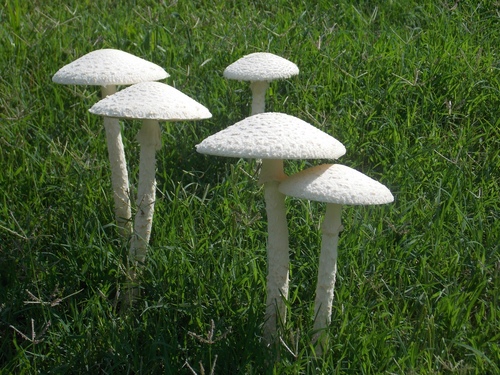
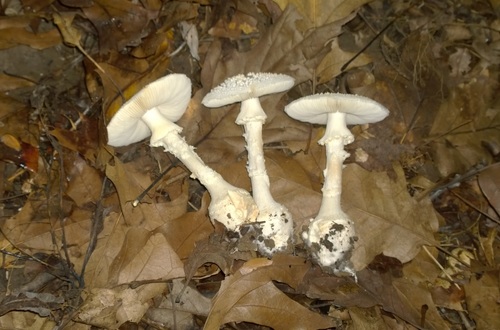
Like most mushrooms, the majority of Amanita abrupta is found underground as a collection of fungal cells called hyphae. Under suitable environmental conditions, the organism produces a visible reproductive structure known as a fruit body. The cap ranges from 4 to 10 centimeters (1+1⁄2 to 4 inches) in diameter. It is broadly convex when young, and eventually flattens, with the central portion becoming depressed in mature individuals. The cap surface is verrucose, meaning it is covered in small angular or pyramidal erect warts that measure 1–2 mm tall and 1–2 mm wide at the base. The warts are smaller and more numerous near the cap margin, and small tissue fragments may hang from the margin. All of the cap surface, warts, and flesh are white. The warts can be easily separated from the cap, and often partially or completely disappear from mature specimens. The white gills are moderately spaced, reach the stem, but are not directly attached to it. The stem is 6.5 to 12.5 cm (2+1⁄2 to 5 inches) tall, slender, and 0.5 to 1.5 cm (1⁄4 to 1⁄2 inch) in diameter. It is white, smooth (glabrous), solid, not hollow internally, and has an abruptly bulbous base shaped like a flattened sphere. Longitudinal splits may develop on the sides of the bulb, and the base is often attached to an abundant mass of white mycelium, which serves as a visible reminder that most of the organism grows unseen below ground. A. abrupta has a membranous, persistent ring that does not weather away over time, and the ring may attach to the stem via white fibers. The mushroom has no distinct odor. When collected as a spore print, spores appear white. Viewed under a microscope, spores are broadly elliptical or roughly spherical, smooth, thin-walled, and measure 6.5–9.5 by 5.5–8.5 μm. Spores are amyloid, meaning they absorb iodine when stained with Melzer's reagent. The spore-bearing basidia on gill edges are four-spored and measure 30–50 by 4–11 μm. Basidia bases have clamp connections, short branches that connect one cell to the previous cell to allow passage of products of nuclear division. The cap cuticle is made of a layer of densely interwoven, slightly gelatinized filamentous hyphae that are 3–8 μm in diameter. Stem tissue is composed of sparse, thin, longitudinally oriented hyphae measuring 294 by 39 μm. Fruit bodies of A. abrupta grow on the ground, typically solitary, in mixed conifer and deciduous forests, usually during autumn. How frequently fruit bodies appear depends on multiple factors including season, location, temperature, and rainfall. The species is described as common in the Southeastern United States; in Texas, it has been called both infrequent overall and common within Big Thicket National Preserve. Like most other Amanita species, A. abrupta is thought to form mycorrhizal relationships with trees. This is a mutually beneficial relationship where the fungus' hyphae grow around tree roots. The fungus receives moisture, protection, and nutritive byproducts from the tree, while the tree gains greater access to soil nutrients. A. abrupta is widely distributed across eastern North America, where it has been recorded as far north as Quebec, Canada, and as far south as Mexico. Orson K. Miller reported finding the species in the Dominican Republic, where it appeared to grow in a mycorrhizal association with pine trees. Kuo also notes a mycorrhizal relationship with both hardwoods and conifers, while Tulloss lists additional preferred tree hosts including beech, birch, fir, tsuga, oak, and poplar. Experiments have shown that A. abrupta does not form mycorrhizae with Virginia Pine.