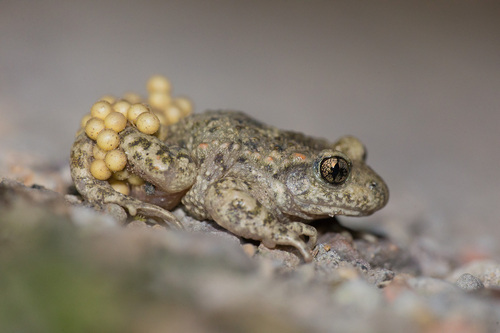
About Alytes obstetricans (Laurenti, 1768)
Size
The common midwife toad (Alytes obstetricans) can grow up to 5.5 centimetres (2.2 in) in length, though most individuals are smaller, with females generally larger than males.
Body Build
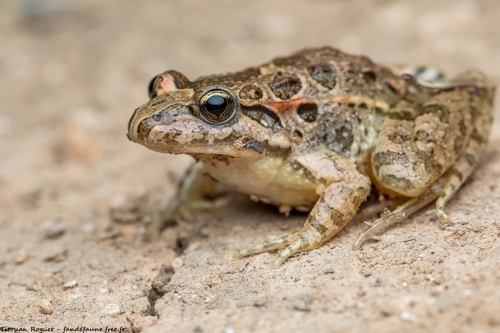
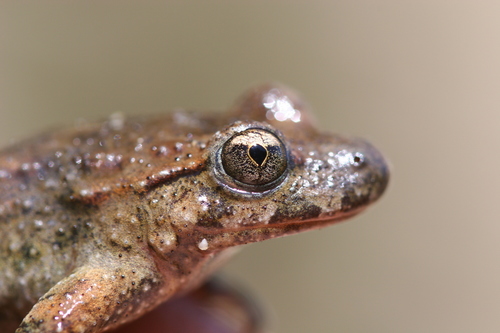
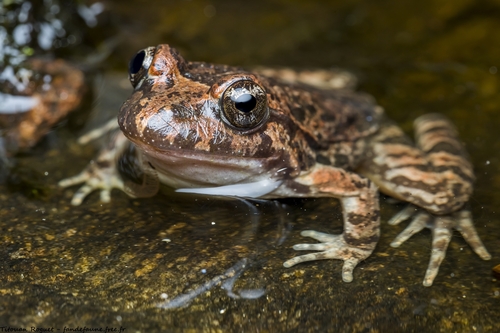
It has a broad, stocky build and a large head with prominent eyes that have vertical slit pupils.
Skin Texture
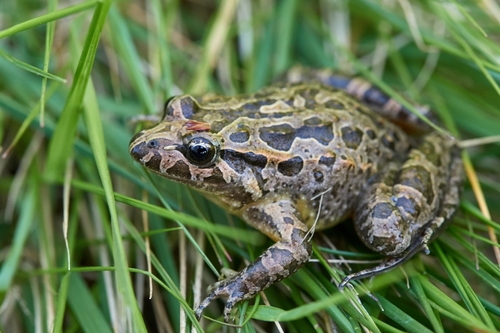
Its skin is mostly smooth, with a few small warts and granules, and a row of large warts running down each side.
Gland Structure
The parotoid glands are small, and additional glands are present in the underarm and ankle regions, with three tubercles on each metacarpal.
Dorsal Colouration
Its colouration is quite variable, most often grey, olive or brown, and sometimes speckled with small greenish or brown spots.
Ventral Colouration
The large warts are often reddish or yellow, and the pale grey underside frequently has darker grey spots on the throat and chest.
General Distribution
The common midwife toad occurs in multiple countries in north-west Europe.
Core Range
It is common across France, and also found in southern Belgium and the Netherlands, Luxembourg, western Germany, and northern and western Switzerland.
Outlying Populations
There are separate disconnected outlying populations in Portugal and northern Spain.
Altitude Range
In the Pyrenees, it can be found at altitudes up to 2,400 metres (7,900 ft).
Habitat Preferences
It usually stays not far from water, but may sometimes wander as far as 500 metres (1,600 ft) away, and often lives in sunny locations including hilly areas, cultivated land, quarries, rocky slopes, gravel pits, woods, parks and gardens.
Activity Pattern
It is active at dusk and throughout the night, and spends the day hidden in undergrowth, crevices, or under logs or stones in locations where it can stay damp.
Burrowing and Hibernation
It can dig a burrow with its forelimbs to rest in, and hibernates on land during the winter.
Introduced Population Origin
Sequencing of 16S and COI gene sequences has confirmed that four introduced populations of the common midwife toad in Bedfordshire, England share the same origin. However, due to limitations in the reference database used, researchers cannot confirm the exact original source location of these populations.
Limb Deformities in Introduced Populations
Researchers have also observed numerous limb deformities in introduced populations of the species found across the United Kingdom, which are likely linked to small founder population sizes.