About Alsophila aescularia (Denis & Schiffermüller), 1775
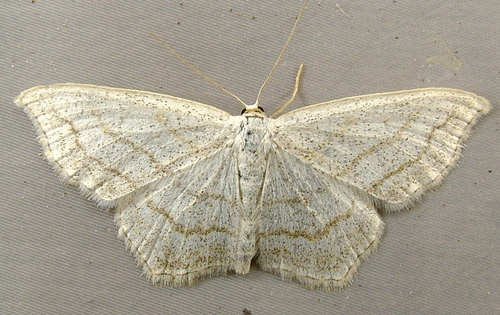
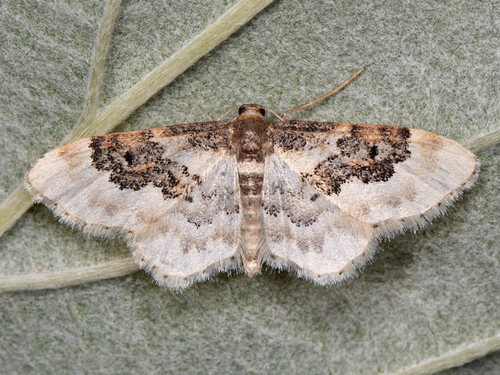
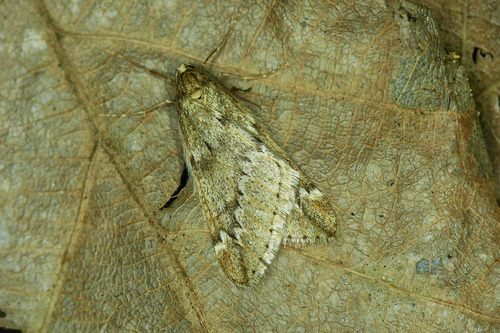
Alsophila aescularia (Denis & Schiffermüller), 1775 is a geometrid moth species. For winged adult males, the wingspan measures 25–35 mm. Forewing colour ranges from pale brownish to grayish brown, with a distinct usually dark brown central band. The forewing lines are sharply toothed, and whitish on the side opposite the central band. Hindwings bear a prominent black dot. Darkened adult specimens are rare; in these individuals, the lines are no longer visible, or the entire moth is solid black. Females are wingless, and measure 8 to 10 millimeters in length. Their abdomen is brownish grey, and their abdominal hair tuft is roughly two millimeters wide, which is narrower than the abdomen – this feature distinguishes females of this species from females of Alsophila aceraria. Females have very short palps, slightly toothed antennae, and a stunted proboscis. The tibiae of their hind legs bear four very short spurs. Adult moths are active during March and April. Fully grown larvae are bright pale-green, and reach a length of approximately 26 mm. They have very smooth skin and a flat head. A dark green dorsal line and yellowish-white lateral lines run along the body. Unlike other geometrid caterpillars, this species has an extra rudimentary abdominal leg pair on the fifth segment. In the southern hemisphere, long, spiderweb-like threads hang from oak trees, and larvae suspend themselves from these threads. Larvae feed on a wide range of tree species: apple (Malus domestica), European plum (Prunus domestica), Zwetschge (Prunus domestica domestica), blackthorn (Prunus spinosa), bird cherry (Prunus padus), lime (Tilia species), pedunculate oak (Quercus robur), sessile oak (Quercus petraea), northern red oak (Quercus rubra), field maple (Acer campestris), sycamore (Acer pseudoplatanus), elm (Ulmus species), hawthorn (Crataegus species), dog rose (Rosa canina), wild privet (Ligustrum vulgare), hornbeam (Carpinus betulus), beech (Fagus sylvatica), hazel (Corylus avellana), ash (Fraxinus excelsior), fly honeysuckle (Lonicera xylosteum), common buckthorn (Rhamnus cathartica) and silver birch (Betula pendula). This species is widespread across most of the western Palearctic region, but is absent from northern Europe, Corsica, Malta, Albania, and the Greek Islands. Outside of Europe, small isolated populations occur in northern and eastern Turkey, the Caucasus, Transcaucasia, and Turkmenistan. It has also been recorded in the Hyrcanian relic temperate deciduous Caspian Forests along the northern slopes of the Alborz Mountain Range in Iran.