About Alpinia purpurata (Vieill.) K.Schum.
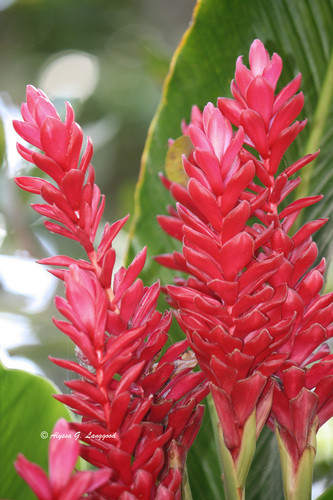
Alpinia purpurata, commonly known as red ginger, ostrich plume, and pink cone ginger, is a species of ginger native to the Maluku Islands and southwest Pacific islands. Like other gingers, A. purpurata is a rhizomatous plant: it grows horizontally through underground rhizomes, sends feeder roots downward into the growing substrate, and produces leafy vertical stems from nodes along the rhizome. As the common name red ginger suggests, this plant produces showy inflorescences held on long, bright magenta to red bracts. While these colorful bracts look like a bloom, they are actually modified leaves that enclose the plant’s true flowers. Bracts are a feature found across many botanical groups, such as species in the genus Euphorbia or the Araceae family; they have evolved to protect the actual flowers, mimic floral structures, and attract pollinators. The plant’s true reproductive flower parts, including pollen, pistil, and stamen, are located inside the bracts, and are typically accessed by crawling insects such as ants or beetles. Red ginger has several named cultivars, including A. purpurata 'Jungle King' and 'Jungle Queen'. This plant now grows in many regions outside its native southwest Pacific range, including Dominica, Grenada, Guadeloupe, Hawaii, Jamaica, Martinique, Puerto Rico, St. Lucia, St. Vincent, Suriname, and Trinidad and Tobago. In Suriname, its Dutch name is bokkepoot, meaning "billy-goat's foot". It also grows in several Central American countries including Belize and Panama, as well as in Samoa, where it is the national flower and is known locally as teuila. Red ginger can be grown successfully in the United States in South Florida and coastal Southern California, because winter low temperatures in these areas rarely reach freezing, usually staying between 45°F and 50°F (about 7°C to 10°C) at the coldest point of the year. In drier, hotter, or sunnier climates outside its native range, the plant may need extra overhead sun protection and regular irrigation. Like many ginger species, red ginger prefers partial shade, indirect light, consistently moist (but not waterlogged) soil, and high ambient humidity. If protected from leaf sunburn, red ginger can tolerate a few hours of full sun early in the day, and extra light can encourage more vivid foliage and more vibrant blooms. Besides being planted in outdoor landscapes, red ginger can also be grown as an indoor houseplant when given adequate light. It can be grown successfully in LECA or PON in full passive or semi-hydroponic setups. Cut red ginger flowers and leaves are commonly used in floral arrangements and tropical bouquets. In Hawaii, red ginger flowers are grown commercially for sale, and have long been associated with the Hamakua area. Once a very common regional flower, it has seen a slight decline in local gardening communities in recent years, but is now starting to make a comeback. Red ginger blooms are sometimes called "graveyard flowers", because they are traditionally placed on the headstones of loved ones, and last a long time as cut flowers due to their vigor and long shelf life.