About Alopochen aegyptiaca (Linnaeus, 1766)
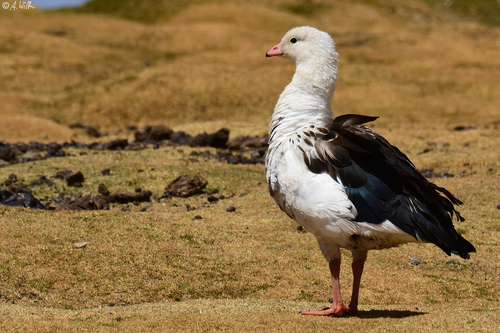
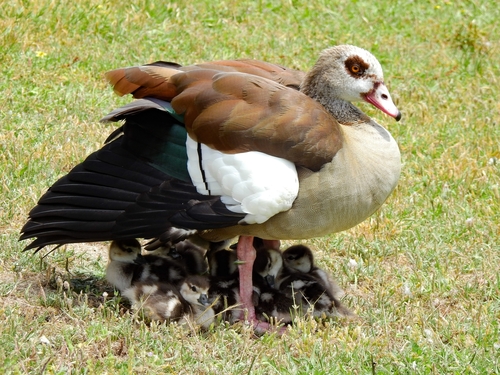
This species is an Egyptian goose, with the scientific name Alopochen aegyptiaca (Linnaeus, 1766). It swims well, and appears heavy in flight, looking more like a goose than a duck, which is how it got its common English name. Adults average 63 to 73 cm (25 to 29 in) tall. The sexes have identical plumage, but males are usually somewhat larger overall. Plumage tone varies greatly between individuals, with some birds being greyer and others browner; this variation has not been linked to sex or age. Most of the wing area of mature birds is white, but this white section is hidden by the wing coverts when the bird is at rest. When the bird is aroused, whether by alarm or aggression, it displays this visible white area. In the wild, Egyptian geese can live up to 15 years, while captive individuals have been recorded living as long as 35 years. Male and female vocalizations differ. The male produces a hoarse, subdued duck-like quack that it rarely uses unless aroused, plus a louder, rapid breathy sequence that sounds similar to a steam engine. The female has a much noisier, raucous quack, and she frequently calls while being aggressive when tending her young. Males attract mates with an elaborate, noisy courtship display that includes honking, neck stretching, and feather displays. The Egyptian goose is native to Sub-Saharan Africa and the Nile Valley, where it is widespread and ranges from common to abundant, though it has become scarce in the northern Nile Valley. It occupies open or semi-open habitats, most often located near fresh water. Its range extends from lowlands up to 4,000 m (13,000 ft) above sea level in the Ethiopian Highlands, and it is largely absent from dense forests and deserts. When not breeding, it disperses to some degree, sometimes making longer migrations north into the arid regions of the Sahel. It occasionally reaches the North African countries of Algeria and Tunisia, which were historically a more frequent part of its range. Until the early 1700s, it was present in southeastern Europe, as far north as the lower Danube Valley and southern Hungary. Until the early 1900s, it was found in parts of Turkey and the western Middle East. It has since re-established these areas through escaped captive birds. Historical ranges of the species in these regions are incompletely known, and the reason for its original disappearance from them is also unknown.