About Aloidendron pillansii (L.Guthrie) Klopper & Gideon F.Sm.
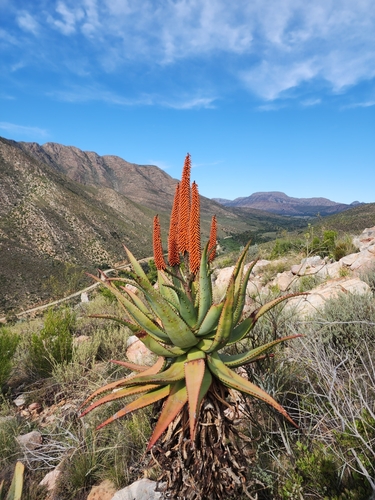
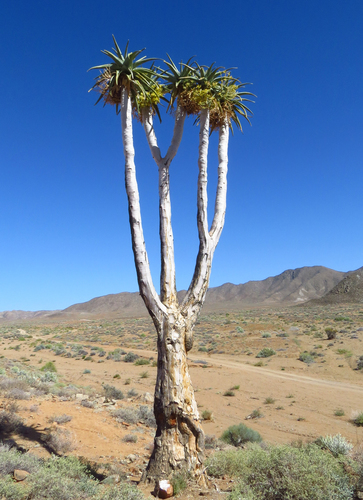
Aloidendron pillansii (L.Guthrie) Klopper & Gideon F.Sm. can grow up to 15 meters in height. It branches dichotomously, and superficially looks like Aloidendron dichotomum. It can be told apart from Aloidendron dichotomum by its paler, wider, recurved leaves, and its taller, more sparsely branched growth form. Its branches are made of soft, penetrable fiber that enables them to store water. Adapted to its native habitat, Aloidendron pillansii can shed branches and leaves that would harm its survival. Its round, bright yellow flowers are pendant, and hang down below the leaf rosette, which is different from the flowers of other tree aloes. These flowers appear in Spring. This species grows naturally near the border between Namibia and South Africa. Its native habitat is upper mountain slopes in arid winter-rainfall Richtersveld shrubland. It is severely threatened by habitat loss, illegal collecting, and livestock grazing, and will not survive without conservation intervention. Aloidendron pillansii rarely appears in cultivation, because it is an extremely slow-growing species that is difficult to cultivate. It requires full sun, extremely well-drained rocky mineral soil, and very dry growing conditions. In its native habitat, it grows on rocky slopes in a desert region that receives sparse rainfall predominantly in the winter.