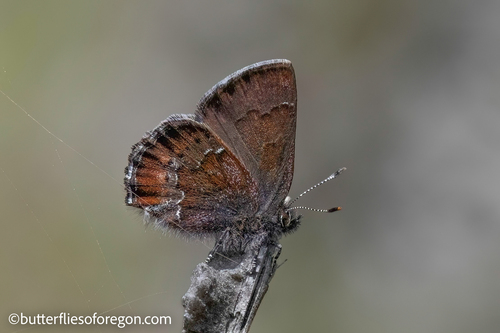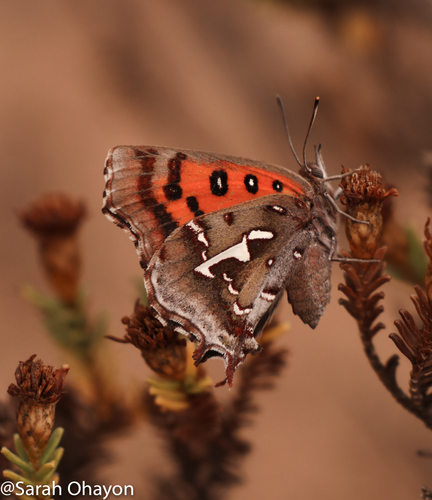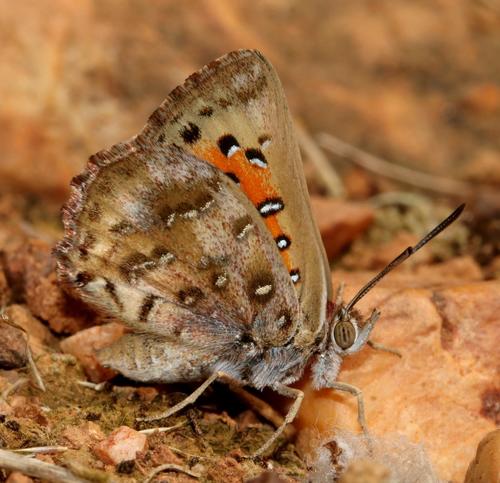
About Aloeides pierus (Cramer, 1782)
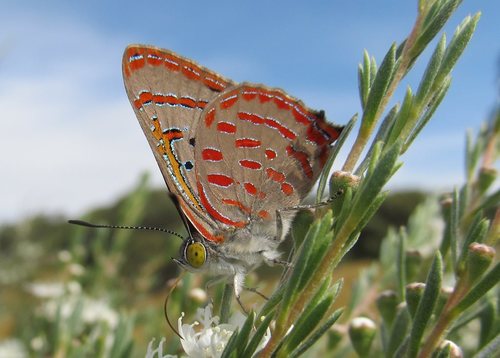
This butterfly species, Aloeides pierus, inhabits grassy areas with bare patches. These habitats include grassy fynbos in the Western and Eastern Cape, and highveld grasslands in other South African provinces. Its wingspan measures 25–30 mm (0.98–1.18 in). Adult Aloeides pierus are active from September to April, with activity peaks in October and February, and there are multiple generations each year. The forewing has 12 veins, and the hindwing has no tail. Males of the Aloeides genus show territorial behavior, claiming specific areas on road verges and unsurfaced roads where they can encounter females and mate. Chitinous spicules are present at the distal end of the tibia in an f-f-a configuration, with a well-developed spur at the lower extremities. Males have a sharp foretarsal claw. A. pierus has long palpi, a robust thorax, and a mesofur that is almost twice the length of the tibia. Females do not have a dense tuft of specialized scales on their abdomen. Genitalia are very similar across species in this genus, so they are not very useful for distinguishing A. pierus from related species. In males, the uncus forms a narrow strip that overlays the large tegumen; its distal edge is slightly convex when flattened, while the subunci are short and have bulging at their bases. The tegumen extends proximally to the eighth abdominal segment. The aedeagus is short with slight dorsal swelling, and curves slightly downwards. It has some fine lateral spines on its outer region. The valves are oblong and contain broad, rounded finger-like apices. The juxta is triangular and notched medially, while the saccus is small and rounded. For the larval stage, the Dorsal Nectary Organ (DNO) develops in later larval instars, mostly starting from the third instar onwards. Larvae of Aloeides pierus feed on species of the genus Aspalathus. They shelter in the nests of the ant species Lepisiota capensis during the day.