About Aloe vera (L.) Burm.f.
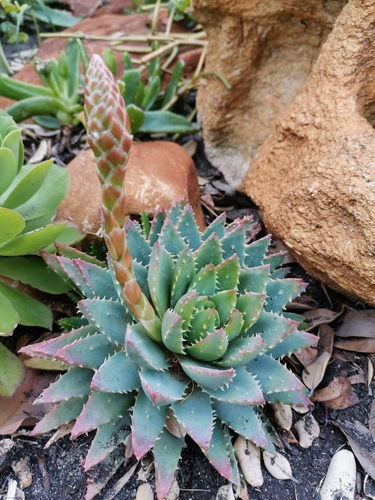
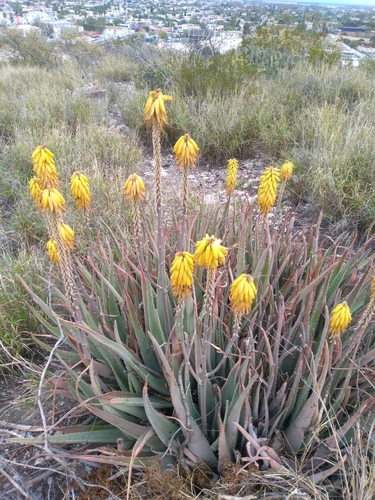
Aloe vera (L.) Burm.f. is a stemless or very short-stemmed plant that reaches 60–100 centimetres (24–39 inches) in height and spreads via offsets. It is considered native to the Hajar Mountains of the south-east Arabian Peninsula, located in north-eastern Oman and eastern United Arab Emirates. However, it has been widely cultivated globally, and naturalized in North Africa, Sudan and neighboring countries, the Canary Islands, Cape Verde, and the Madeira Islands. It has also naturalized in Portugal’s Algarve region and across wild areas of Spain, particularly the Murcia region. The species was introduced to China and various parts of southern Europe in the 17th century, and is widely naturalized elsewhere, growing in arid, temperate, and tropical regions of temperate continents. Its current full distribution may be the result of widespread cultivation.
Orally ingested non-decolorized aloe vera leaf extract has been listed by the California Office of Environmental Health Hazard Assessment as one of the "chemicals known to the state to cause cancer or reproductive toxicity", a risk possibly linked to its anthraquinone content. Since 2016, the International Agency for Research on Cancer has classified aloe vera whole leaf extract as a possible human carcinogen (group 2B). Topical use of aloe vera on the skin is generally not associated with significant side effects. Oral ingestion of aloe vera is potentially toxic, and may cause abdominal cramps and diarrhea; these effects in turn can reduce the absorption of prescription drugs.
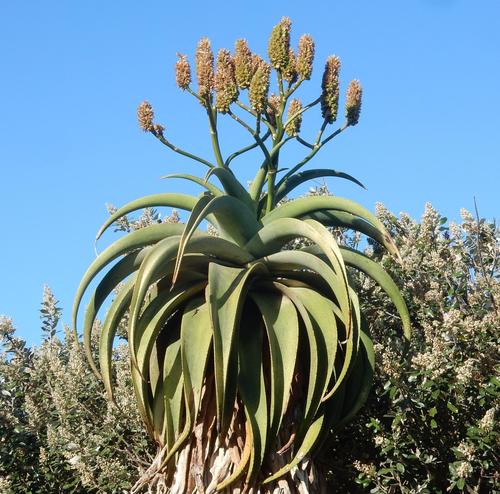
Aloe vera has long been widely grown as an ornamental plant. It is popular among modern gardeners both as a topical medicinal plant and for its distinct flowers, growth form, and succulence. This succulence allows it to survive in areas with low natural rainfall, making it ideal for rockeries and other low-water gardens. It is hardy in USDA zones 8–11, and cannot tolerate heavy frost or snow. The species is relatively resistant to most insect pests, though spider mites, mealy bugs, scale insects, and aphids may cause declines in plant health. It has been awarded the Royal Horticultural Society's Award of Garden Merit. When grown in pots, it requires well-drained sandy potting soil and bright, sunny conditions. Aloe plants can develop red sunburn from excessive direct sun, though gradual acclimation to full sun can prevent this. Good-quality commercial propagation mixes or packaged "cacti and succulent mix" are recommended, as these provide excellent drainage. Terra cotta pots are preferred because they are porous. Potted aloes should be allowed to dry completely between waterings. Potted plants often become crowded with "pups" that grow from the sides of the mother plant. Crowded clumps can be divided and repotted to give more room for growth, or the pups can be left attached to the mother plant. Aloe vera goes dormant during winter, requiring very little moisture in this period. In regions that experience frost or snow, the species is best kept indoors or in heated glasshouses. Large-scale agricultural production of Aloe vera takes place in Australia, Cuba, the Dominican Republic, China, Mexico, India, Jamaica, Kenya, Tanzania, South Africa, Spain, and the United States, with most of the harvest going to the cosmetics industry.
Two distinct substances from Aloe vera—its clear inner gel and yellow latex—are used to manufacture commercial products. Aloe gel is most commonly used to make topical medications for skin conditions including burns, wounds, frostbite, rashes, psoriasis, cold sores, and dry skin. Aloe latex is used alone or combined with other ingredients in ingested products to relieve constipation. Aloe latex can be processed into a dried form called resin, also referred to as "aloe dried juice". There is conflicting scientific evidence about whether Aloe vera is effective for treating wounds or burns. Some evidence indicates that topical aloe products may relieve symptoms of certain skin disorders like psoriasis, acne, or rashes, but topical use can trigger an allergic reaction in some people. Aloe vera gel is also used commercially as an ingredient in yogurts, beverages, and some desserts, though ingesting aloe latex or whole leaf extract can be toxic at high or prolonged doses. Small amounts of topical aloe vera are very likely to be safe for use.
Aloe vera may be prepared as a lotion, gel, soap, or cosmetic product for use as a topical skin medication. For people with allergies to Aloe vera, skin reactions can include contact dermatitis with mild redness and itching, difficulty breathing, or swelling of the face, lips, tongue, or throat.
Aloe vera has been used as a skin treatment in traditional medicine. The earliest written records of its use date to the fourth millennium BCE, and it is also documented in the Juliana Anicia Codex completed in 512 CE.