About Aloe speciosa Baker
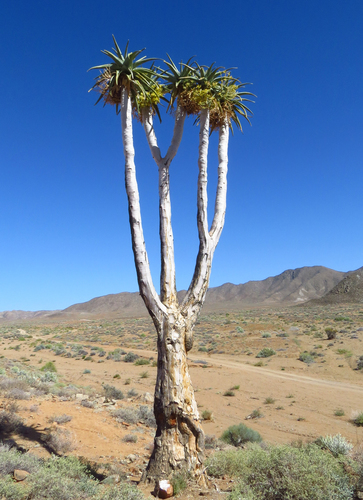
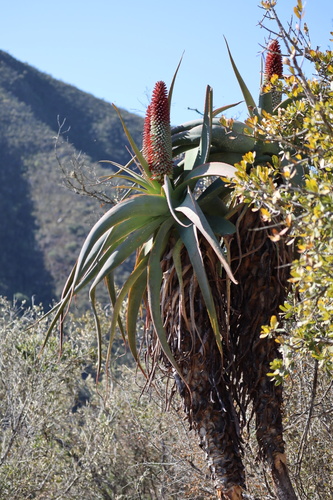
Aloe speciosa Baker, commonly called the tilt-head aloe, gets its common name from the characteristic tilt of its leaf rosette. This rosette always tilts toward the direction that receives the most sun; in its native habitat, this direction is usually north, so the plant effectively acts as a natural compass. It is a tall, arborescent aloe species. Its long, thin, drooping pale blue-green leaves are densely clustered around the tilted rosette. Its pinkish leaf margins are lined with reddish teeth. When it flowers in early spring, it produces several short, cylindrical, single-branched inflorescences. The dense flowers on these inflorescences are red or green with white stripes. The Latin species epithet speciosa means showy, and the name was chosen specifically to refer to this plant’s decorative ornamental flowers. This species is also sometimes known by the synonym Aloe hexapetala; this alternate name also refers to the plant’s flowers, as the epithet hexapetala means six-petaled. Tilt-head aloe grows in two separate disjunct populations in South Africa. One population is found in south-central Western Cape province, ranging from near Swellendam to the Little Karoo. The second, larger population covers much of the southern part of Eastern Cape province, extending as far as the border of Transkei. In this native range, it most often inhabits dense thickets, particularly within the Albany Thicket biome. It frequently grows alongside Aloe ferox, Aloe africana, and Aloe pluridens, and natural hybrids between these species can occur.