About Aloe rupestris Baker
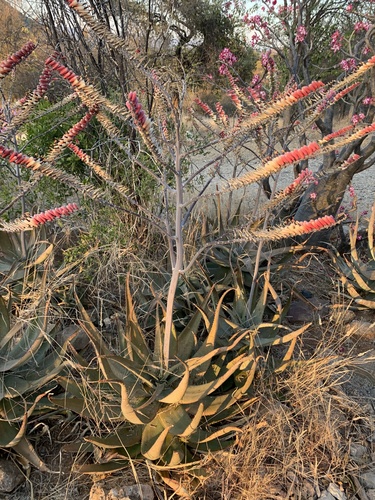
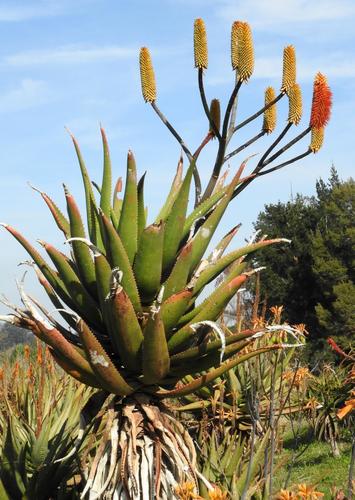
This species is commonly known as bottlebrush aloe, and it gets this common name from its distinctive, showy flowers. Large candelabra-shaped inflorescences grow tall above the plant's leaf rosette. Each inflorescence holds numerous straight, upright, cylindrical racemes. Individual flowers start as densely packed tight yellow buds along the racemes. When the flowers open, bright reddish stamens extend far outward, giving each raceme a fluffy, bottlebrush-like appearance. Aloe rupestris is a very fast-growing aloe. In its natural habitat, it is usually single-stemmed, though clumping, offsetting forms can appear when it is grown in cultivation. Compared to other tree-like arborescent aloes, Aloe rupestris grows extremely tall and has a relatively thin trunk. For this reason, especially tall specimens sometimes fall over if they do not have support. In its natural habitat, this species tends to grow among rocks and thickets that provide this needed support. The thin, partially recurved, spreading leaves form a dense rosette at the growing tip of mature plants. The leaves are smooth, dull green, and deeply grooved, with a U-shaped cross-section. They have reddish-brown margins and slightly hooked teeth. This species is often confused with several related aloes that share a similar growth form, including Aloe thraskii, Aloe marlothii, Aloe ferox, Aloe speciosa, Aloe pluridens and Aloe excelsa, among others. However, the bottlebrush aloe has a very distinctive inflorescence that makes its overall growth form recognizable. In contrast to Aloe rupestris, Aloe excelsa has sloping or curved racemes, while Aloe thraskii has more robust, strongly recurved leaves. Aloe rupestris occurs naturally across the south-eastern summer-rainfall areas of Kwazulu-Natal Province, South Africa, as well as Eswatini (Swaziland) and southern Mozambique. Across this range, it favours rocky areas in bushveld, sandy coastal forest, and hilly areas, where it grows on rocky ridges and slopes. The species epithet rupestris means "of rocky places" in Latin, referring to this favoured habitat.