About Aloe petricola Pole-Evans
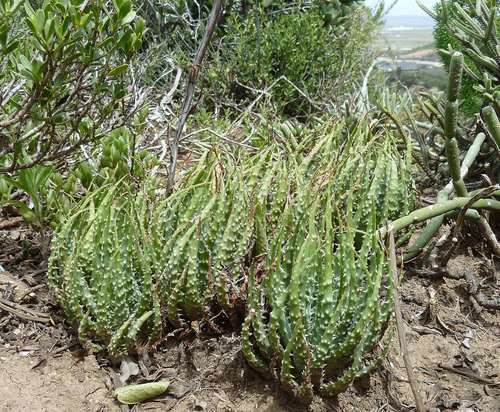
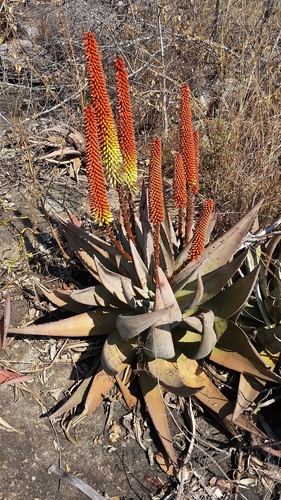
Aloe petricola is a medium-sized succulent that grows fairly low to the ground. It reaches between 18 and 24 inches in height, and can grow a little over one meter wide. Its inflorescences can reach about 4 feet, which is taller than the plant's fleshy leaves. This species is virtually stemless, and produces rosettes of blue-green leaves. The leaves have thorns on their surfaces, and short, triangular teeth along their margins. A mature Aloe petricola can have up to six flower branches, which form long, narrow, densely flowered racemes held on stout stems. The inflorescences are tightly packed with dark brown anthers, and typically have at least two colors: deep red towards the top where the unopened buds are located, and cream-yellow towards the bottom near the flower stem. The flowers of Aloe petricola are tube-shaped and around 30mm long. Their bright, vibrant colors change as the flowers open, revealing more yellow color towards the base of the inflorescence. Aloe petricola is native to South Africa, specifically the Mpumalanga province. It tends to grow in rocky locations, where the plant is surrounded by stones, and soil only covers its roots. The species epithet petricola refers to this preference for rocky places; the name breaks into 'petri', meaning stone, and 'cola', meaning fond of. Sunbirds often pollinate Aloe petricola, and feed on the nectar from its flowers. This species is widely used in traditional medicine. While aloes most commonly Aloe vera are known for treating minor wounds and burns, the sap-filled leaves of Aloe petricola have been frequently used for centuries as a remedy to heal stomach ailments.