About Aloe marlothii A.Berger
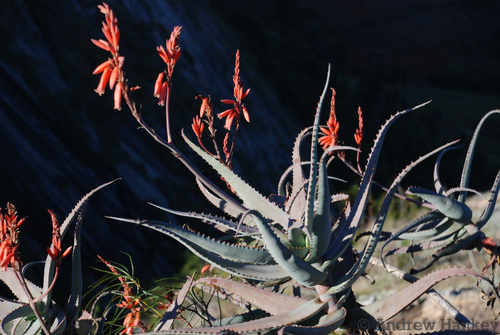
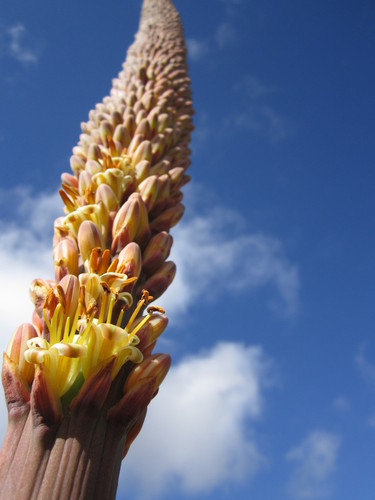
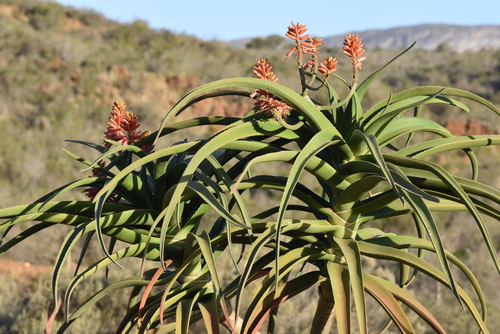
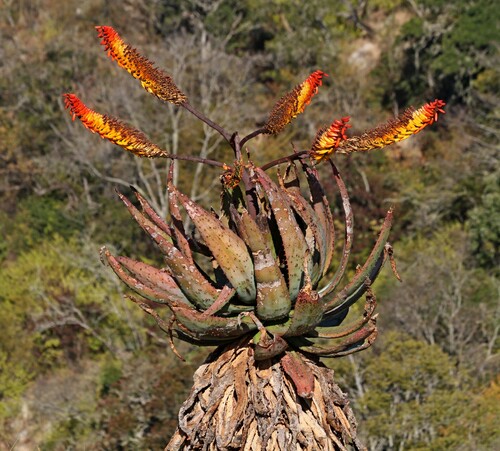
Aloe marlothii A.Berger is named after Rudolf Marloth, a German-born South African botanist. This aloe species has a particularly large, robust rosette of stiff, grey-green leaves. These leaves can reach up to 1.8 m (5 ft 11 in) in length, 30 cm (12 in) in width, and around 4 cm (1.6 in) in thickness. The leaves are usually densely covered in short spines on their convex lower surfaces, with fewer spines on the concave upper surfaces. Like many other arborescent aloe species, Aloe marlothii is more spiny when it is small. As it grows taller and becomes less vulnerable to grazing, it loses many of the spines from its leaf surfaces. It typically has a trunk that is densely covered in withered old leaves. Its inflorescence is a much-branched panicle, which can hold up to 30 racemes, and exceptionally up to 50 racemes. Flower colour varies widely, ranging from yellow through orange (the most common colour) to bright red. As with most aloes, Aloe marlothii flowers during the winter months. The distinctively horizontal branches of its inflorescence make this species easy to distinguish from other aloes, which is why it is sometimes called the flat-flowered aloe. However, the type known as Aloe spectabilis has taller, less horizontal inflorescences. The densely packed flowers of Aloe marlothii all tend to point upwards from the raceme. When not in flower, it is easily confused with the closely related Aloe excelsa (Zimbabwe aloe), as well as the similar-looking southern species Aloe ferox (Cape aloe) and Aloe africana (African aloe).
The distribution of Aloe marlothii extends from Klipriviersberg Nature Reserve in Johannesburg, through eastern Botswana, northwards across the Soutpansberg to Zimbabwe and Malawi, and eastwards through Eswatini and Mozambique to the coast. Within this range, it is especially common in mountainous areas, which has led to it being known as the mountain aloe. This species grades into Aloe spectabilis Reynolds of KwaZulu-Natal through intermediate forms. Aloe marlothii naturally hybridises with around 30 or more other aloe species.