About Aloe macroclada Baker
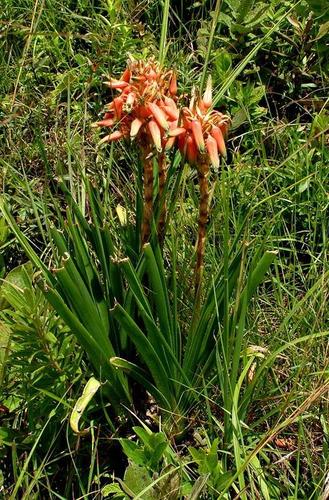
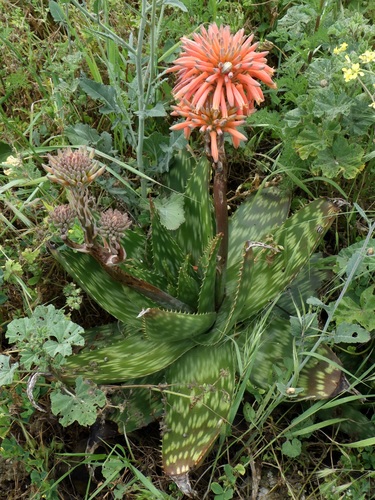
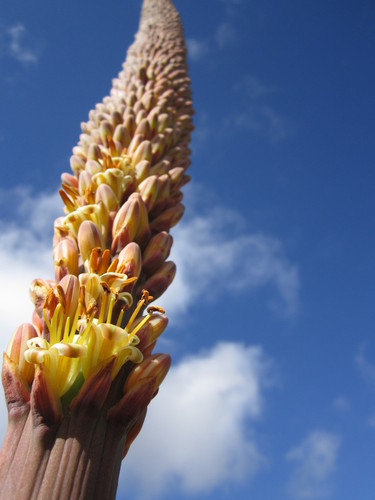
Aloe macroclada Baker is a slow-growing aloe species that begins flowering when it is four to five years old. In its native Madagascar, it flowers during the latter half of the dry season, from August to October. This species produces a large, erect, normally unbranched raceme that holds many small orange or yellow flowers. Its wide, thick leaves are arranged in an orderly symmetrical pattern, stacked with three leaves spaced 120 degrees apart. Mature leaves can grow over 1 meter (3.3 feet) in length, over 20 centimeters (7.9 inches) wide at the base, and over 3 centimeters (1.2 inches) thick. The leaves typically curve slightly upward, and will curve sideways when the plant grows on sloped ground. Leaves are arranged in a dense apical rosette, spreading outward, with a medium to dark green surface that turns reddish when the plant is under stress. Each leaf’s margins bear lines of small, reddish to yellow teeth, a common trait across the Aloe genus. Distinguishing characteristics of Aloe macroclada include: yellow-orange flowers covering the top 30 to 60 centimeters (12 to 24 inches) of its usually single flower stalk; large, tall racemes that taper to a point; wide spreading leaves arranged in a relatively untidy rosette. The oldest leaves rest against the ground, and the species does not form a trunk or stem. It is not known to produce offsets (pups) or shoots.