About Aloe globuligemma Pole-Evans
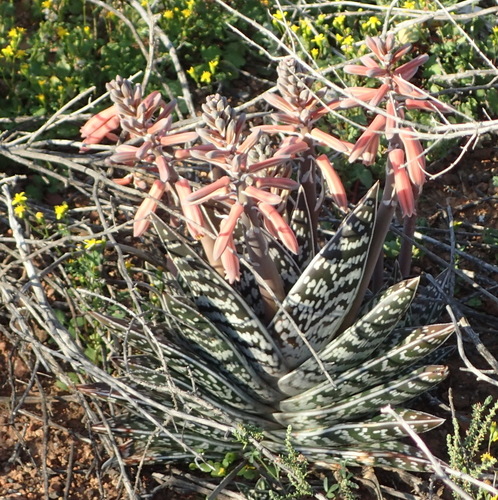
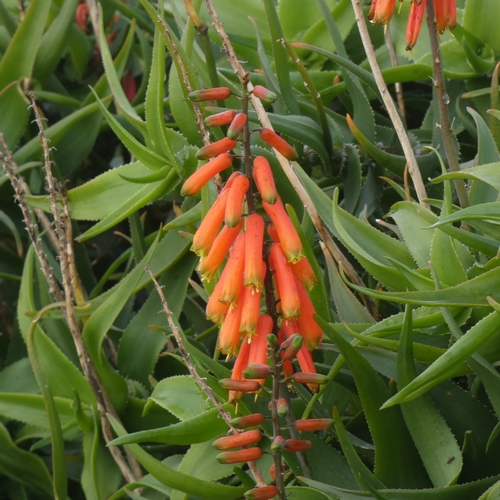
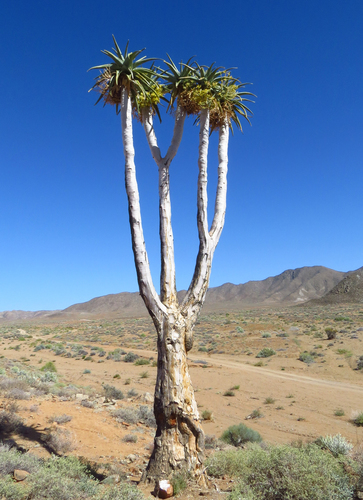
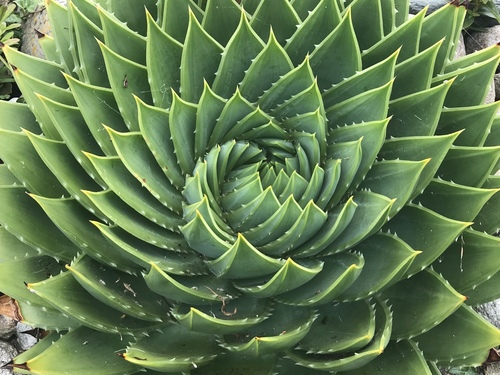
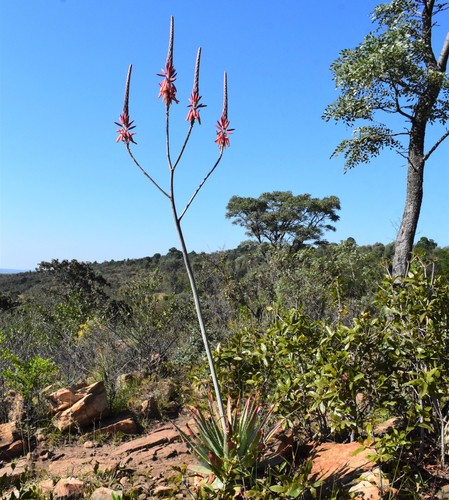
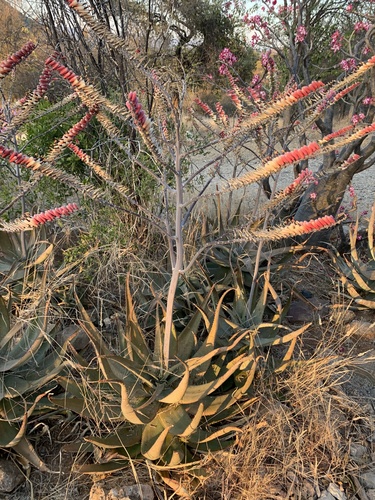
Aloe globuligemma Pole-Evans was first described by Illtyd Buller Pole-Evans, with the original publication of the description in 1915. This aloe species grows with short stems that can reach up to 50 cm (20 in) in length, forming large, dense clumps through sprouting. It also produces creeping stems that reach up to 50 cm (20 in) long. Approximately 20 lance-shaped leaves grow together in a rosette arrangement. Individual leaves measure 45–50 cm (18–20 in) long and 8–9 cm (3.1–3.5 in) wide. Along the leaf margins are teeth that are milky white with pale brown tips; each tooth is 2 mm (0.1 in) long, spaced at 10 mm (0.4 in) intervals, and most teeth point toward the tip of the leaf. This species occurs in Botswana, Zimbabwe, and the South African provinces of Limpopo and Mpumalanga. It grows in hot dry areas and bushlands located at elevations between 600–1,325 m (2,000–4,300 ft). It often forms large colonies, growing in bare or sparsely grassed locations, eroded areas, and open deciduous woodland. Aloe globuligemma is used in traditional African medicine. Traditionally, a leaf infusion of this species is taken to treat stomach ache, treat venereal diseases, and used as an abortifacient.