About Aloe ferox Mill.
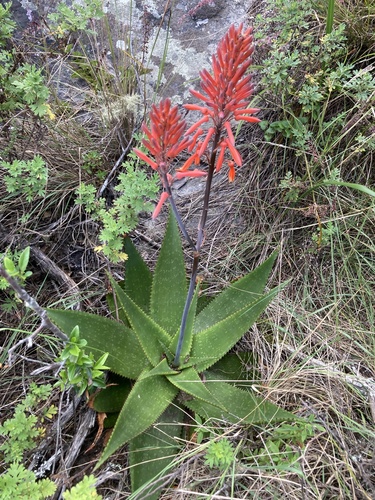
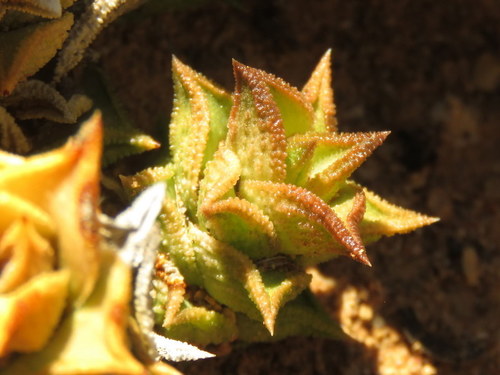
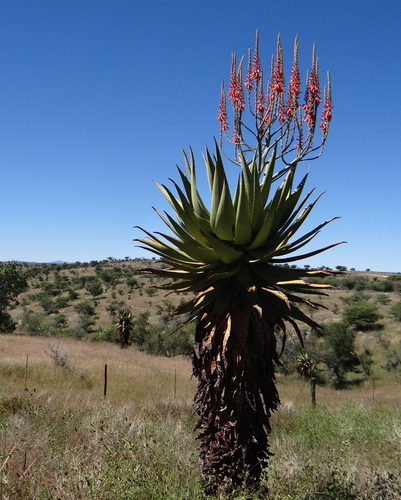
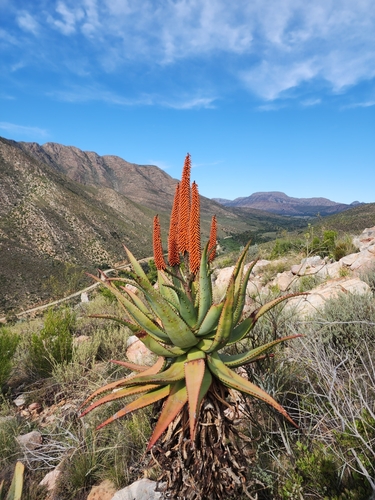
Aloe ferox Mill. is a tall, single-stemmed aloe that can reach 3.0 meters (10 feet) in height. It has thick, fleshy leaves arranged in rosettes. Reddish-brown spines grow along the leaf margins, with smaller spines covering the upper and lower leaf surfaces. Young plants have spines covering their entire leaf surfaces; as plants grow taller and become less vulnerable to grazing, they lose most of their leaf surface spines, retaining only the spines along the margins. Plants growing in the western part of its natural range typically retain more leaf surface spines. Its flowers are uniformly orange or red, borne on multi-branched inflorescences that stand 0.61 to 1.22 meters (2 to 4 feet) above the leaves. This is a variable species, and individual plants can have different physical traits in different areas due to local growing conditions. It is often confused with the related Aloe excelsa, which grows to the north, and the two species look very similar when fully mature. However, their flowers differ: the racemes of Aloe excelsa are much shorter and slightly curved. Overall, bitter aloe can be distinguished from its closest relatives by multiple traits: its more compact, erect leaves that have 6mm reddish-brown teeth on the margins and also on the leaf keel near the leaf tip; its erect candelabra inflorescences, which can hold up to eight very dense, cylindrical, symmetrical racemes between 50 and 80 cm long; and its uncurved, tubular flowers with brown tips on the inner segments. Its large natural range forms a nearly continuous band across the northern Limpopo province and southern Cape, stretching from Swellendam and the Overberg District in the west, across almost the entire Eastern Cape Province, eastward to southern KwaZulu-Natal, and northward into the southern parts of the Free State and Lesotho. Across this range, it is most commonly found in rocky areas on hills, in grassy fynbos, and on the edges of the Karoo. Aloe ferox has several common names: it is most often called bitter aloe, and is also known as Cape aloe, red aloe, and tap aloe. It is primarily propagated from seed and head cuttings, with planted specimens spaced approximately one meter apart. Plants grown from seed take 4 to 5 years to reach the first harvest. At harvest, each leaf weighs between 1.5 kg and 2 kg. It prefers dry-tropical climates, open growing areas, sandy-loamy soils, full sun, moderate watering, and a drainage system that works well.