About Aloe africana Mill.
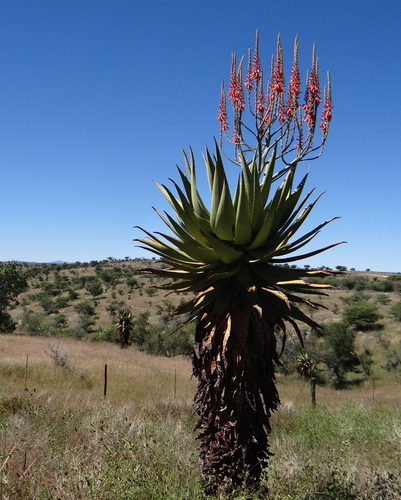
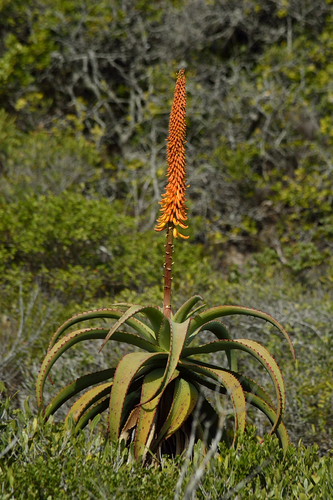
Aloe africana Mill. is a slow-growing aloe that begins flowering when it is four to five years old. Its flowering season runs from winter to early spring, which corresponds to July to September in South Africa. It produces large, erect racemes that may be unbranched or have up to four branches. The flowers are tubular, orange or yellow, small, uniquely up-turned, and have a distinctive bend. This characteristic bent flower shape is helpful for identifying this species, because Aloe africana can sometimes look very similar to related aloes including Aloe excelsa, Aloe lineata, and Aloe ferox.
This species has thin, narrow leaves that grow in a less orderly, messy arrangement compared to the neat symmetrical rosettes formed by other arborescent Aloe species. Its leaves are also more recurved than related species. The leaves are arranged in a dense apical rosette, spreading to recurved, firm, and linear-lanceolate, with a grey-green surface. Like most Aloe species, the margins and lower surface of each leaf bear lines of small reddish teeth. The key distinguishing features of Aloe africana are: yellow-orange flowers bent to almost 90 degrees; large, tall, tapering racemes; and narrow, spreading or recurved leaves arranged in a relatively untidy rosette.
This attractive species is native to the Eastern Cape of South Africa, with a distribution centered around the Port Elizabeth and Uitenhage area. It is mainly restricted to hills and flat terrain, where it grows in thicket and renosterveld vegetation, though it can adapt to a wide range of growing conditions. It often grows alongside Aloe ferox, Aloe pluridens, and Aloe speciosa, and hybrids between these species are not uncommon. Its native habitat has a moderate climate with no frost, hot humid summers, and year-round rainfall that totals 600 to 700 mm per year.