About Alnus incana (L.) Moench
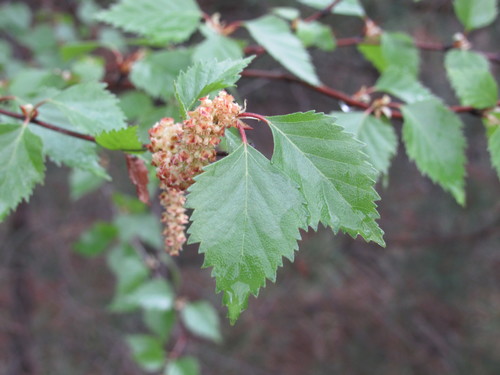
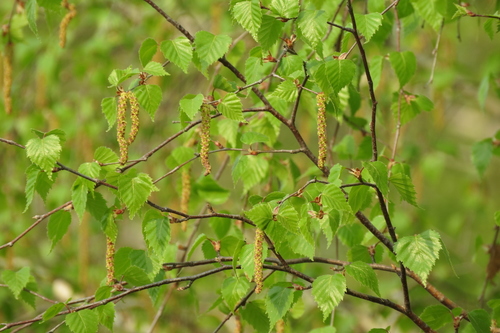
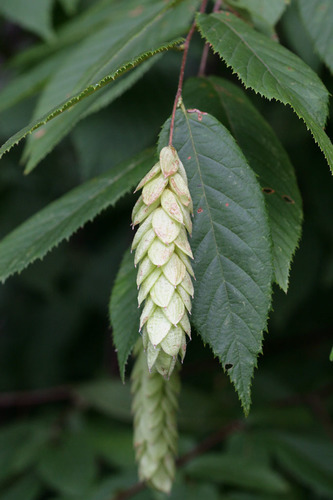
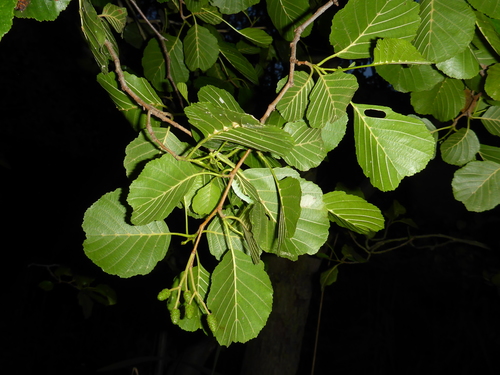
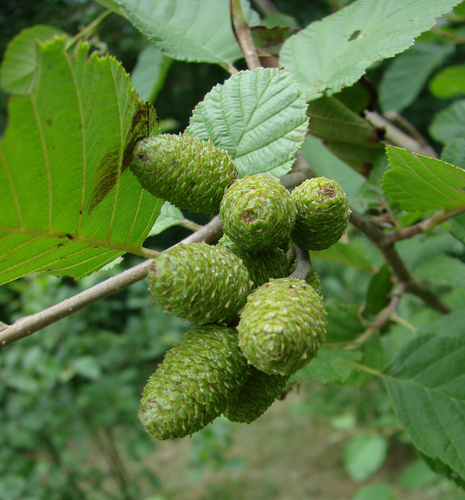
Alnus incana (L.) Moench, commonly called grey alder, is a small to medium-sized tree that reaches 15–20 metres (49–66 ft) in height. It has smooth grey bark even when old, and has a maximum lifespan of 60 to 100 years. Its leaves are matte green, ovoid, and measure 5–11 centimetres (2–4+1⁄4 in) long by 4–8 cm (1+1⁄2–3+1⁄4 in) broad. It produces catkin flowers that emerge early in spring before new leaves appear. Male catkins are pendulous, growing 5–10 cm (2–4 in) long, while female catkins reach 1.5 cm (5⁄8 in) long and one cm broad when they mature in late autumn. Its seeds are small, 1–2 millimetres (1⁄32–3⁄32 in) long, light brown, and have a narrow encircling wing. Grey alder has a shallow root system, and produces vigorous stump suckers as well as root suckers, this is especially common in the northern parts of its range. Its wood is similar to that of black alder (Alnus glutinosa), but is somewhat paler and has little economic value. Alnus incana is a light-demanding, fast-growing tree that grows well on poorer soils. In central Europe, it colonizes alluvial land alongside mountain brooks and streams, and occurs at elevations up to 1,500 metres (4,900 ft). It does not require moist soil, and will also colonize screes and shallow stony slopes. In the northern part of its range, it is a common tree at sea level in forests, abandoned fields, and on lakeshores. Several species of Lepidoptera use grey alder as a food plant for their caterpillars. In the boreal forest of Canada, A. incana is often associated with black spruce in the forest type called black spruce–speckled alder. Larvae of the alder woolly sawfly sometimes cause considerable defoliation to grey alder. A. rugosa provides cover for wildlife, is browsed by deer and moose, and its seeds are eaten by birds. This tree is cultivated in parks and gardens. The cultivar 'Aurea', which has green-gold leaves, has received the Royal Horticultural Society's Award of Garden Merit. It is sometimes used for afforestation and agroforestry on non-fertile or wet soils; it enriches these soils through nitrogen-fixing bacteria that live in its root nodules. Alder is an excellent tree for coppicing and pollarding. Cut branches may be fed to browsing livestock such as cows and goats, after which they can be used for kindling, firewood, or light construction, while the root systems fertilize adjacent agricultural plots through nitrogen fixation. The Zuni people use bark from the tenuifolia subspecies to dye deerskin reddish brown. The Ho-Chunk people eat bark from the rugosa subspecies to soothe sour or upset stomachs. The wood and bark of this tree are used in smoking meat, particularly fish and duck.