About Alnus glutinosa (L.) Gaertn.
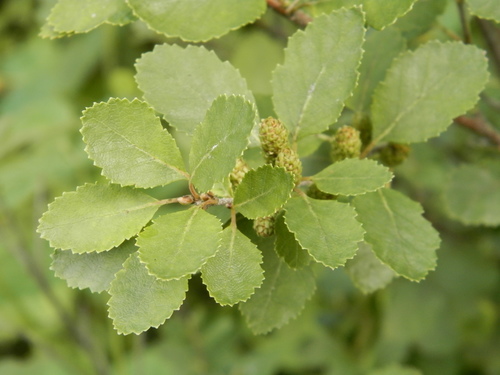
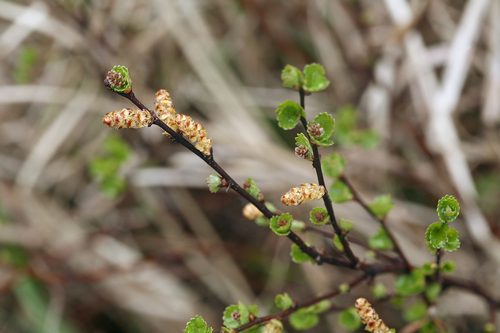
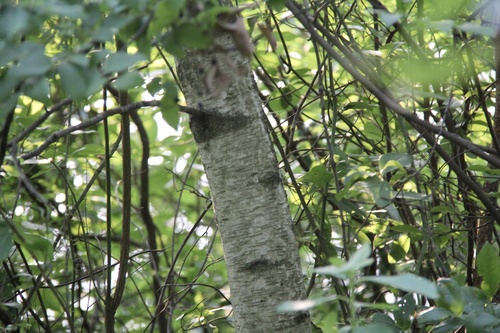
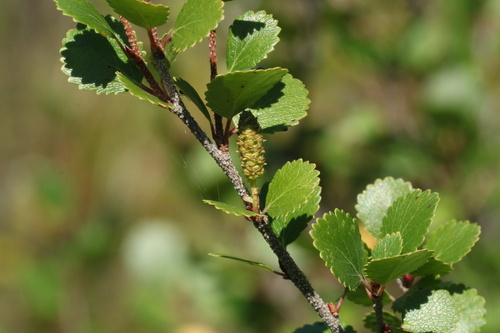
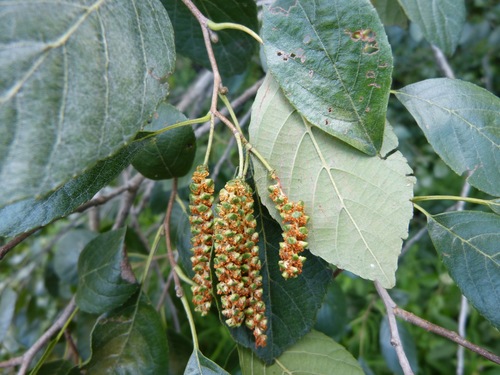
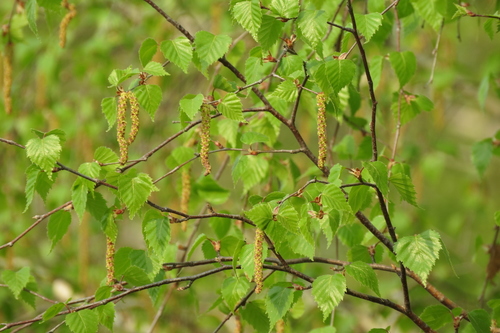
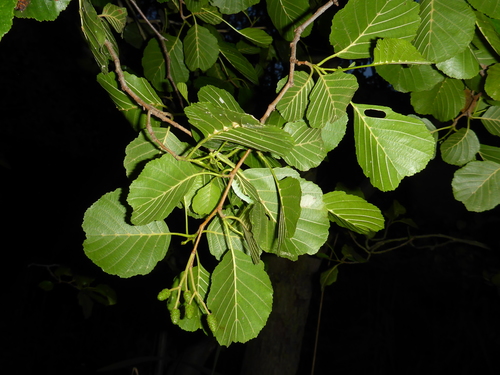
Alnus glutinosa (L.) Gaertn., commonly known as common alder or European alder, is a tree that thrives in moist soils. Under favorable growing conditions, it reaches a height of 20 to 30 meters (66 to 98 feet), and may exceptionally grow up to 37 m (121 ft). Young trees grow upright with a main axial stem, while older trees develop an arched crown with crooked branches. Adventitious roots grow from the trunk base down into the soil, and may appear to prop up the trunk. Young trees have smooth, glossy, greenish-brown bark, while older trees have dark grey, fissured bark. Branches are smooth and somewhat sticky, scattered with resinous warts. Buds are purplish-brown and short-stalked. Both male and female catkins form in autumn and remain dormant over winter. The leaves are short-stalked and rounded, growing up to 10 centimetres (4 inches) long, with a slightly wedge-shaped base and a wavy, serrated margin. The upper leaf surface is glossy dark green, while the underside is paler green with rusty-brown hairs in the vein angles. Like other water-adjacent trees, common alder retains its leaves longer than trees growing in drier locations, and leaves stay green late into autumn. As the specific epithet glutinosa suggests, buds and young leaves are sticky with resinous gum. This species is monoecious, and its flowers are wind-pollinated. Slender cylindrical male catkins are pendulous, reddish, and 5 to 10 cm (2 to 4 in) long. Female flowers are upright, broad, green, and short-stalked. In autumn, female structures mature to dark brown or black, becoming hard and somewhat woody, and superficially resemble small conifer cones. These structures persist through winter, and most small winged seeds are dispersed the following spring. Seeds are flattened reddish-brown nuts edged with webbing that contains air pockets, allowing them to float for around a month, which supports wide seed dispersal. Unlike some other tree species, common alder does not produce specialized shade leaves. Shaded foliage has the same respiration rate as well-lit foliage, but a lower assimilation rate. As a result, lower branches die and decay as the tree grows taller in woodland, leaving a small crown and unbranched trunk. Common alder is native to almost all of continental Europe, excluding only the extreme north and extreme south, as well as the United Kingdom and Ireland. In Asia, its range includes Turkey, Iran, and Kazakhstan, and it is found in Tunisia, Algeria, and Morocco in Africa. It is naturalized in the Azores, and has been introduced both accidentally and intentionally to Canada, the United States, Chile, South Africa, Australia, and New Zealand. Its natural habitat is moist ground near rivers, ponds, and lakes, but it can also grow in drier locations, and sometimes grows in mixed woodland and on forest edges. It tolerates a range of soil types, and grows best at a pH between 5.5 and 7.2. Through its association with the nitrogen-fixing bacterium Frankia alni, it can grow in nutrient-poor soils where few other trees thrive. European alder does not usually grow in areas where the average daily temperature stays above freezing for longer than six months. Its range is mainly restricted in southern Scandinavia, though it occurs in other regions as well. It requires 500 millimeters of annual rainfall along the southeastern boundary of its distribution in Eurasia. While European alder can survive winter temperatures as low as −54 °C, winter damage causes 80% of young European alder plantings in North Carolina to die back. Where the overwinter minimum temperature is −18 °C, early low temperatures in November and December appear to cause more damage than extreme intense cold. Common alder is most well known for its symbiotic relationship with the bacterium Frankia alni, which forms nodules on the tree's roots. This bacterium captures nitrogen from the air and fixes it into a form the tree can use. In exchange, the bacterium receives carbon products produced by the tree through photosynthesis. This relationship improves soil fertility, making common alder an important pioneer species in ecological succession. Common alder is susceptible to Phytophthora alni, a recently evolved oomycete plant pathogen likely of hybrid origin. This pathogen causes phytophthora alder disease, which has led to extensive mortality of common alder in some parts of Europe. Infection symptoms include root death, death of patches of bark, dark spots near the trunk base, leaf yellowing, and in subsequent years branch death and sometimes death of the whole tree. Taphrina alni, a fungal plant pathogen, causes alder tongue gall, a chemically induced distortion of female catkins that develops on maturing fruits. The gall produces spores that are wind-carried to other trees, and this gall is believed to be harmless to the tree. Another harmless gall is caused by the midge Eriophyes inangulis, which sucks sap from leaves to form pustules. Common alder is valuable to wildlife year round. Its seeds are a useful winter food source for birds. Deer, sheep, hares, and rabbits feed on the tree, and it provides shelter for livestock in winter. It shades river and stream water to moderate water temperature, which benefits fish; fish also find shelter among its exposed roots during floods. Common alder is a food plant for the larvae of many butterfly and moth species, and is associated with over 140 species of plant-eating insects. It also hosts a variety of mosses and lichens, which thrive particularly well in the humid environment of streamside alders. Common lichens found on the trunk and branches include tree lungwort (Lobaria pulmonaria), Menneguzzia terebrata, and Stenocybe pullatula, the last of which only grows on alders. Forty-seven species of mycorrhizal fungi have been found growing in symbiosis with common alder, with both partners benefiting from nutrient exchange. Alongside several species of Naucoria, these symbionts include Russula alnetorum, the milkcaps Lactarius obscuratus and Lactarius cyathula, and the alder roll-rim Paxillus filamentosus, all of which grow only in association with alders. In spring, the catkin cup Ciboria amentacea grows on fallen alder catkins. As an introduced species, common alder can alter the ecology of its new location. It grows quickly and can rapidly form dense stands that block light from reaching the ground, which may inhibit the growth of native plants. The presence of nitrogen-fixing bacteria and annual accumulation of leaf litter also changes the soil's nutrient status, and increases phosphorus availability in the ground. The tree's dense root network can increase sedimentation in pools and waterways. It spreads easily by wind-borne seed, may be dispersed to some degree by birds, and its woody fruiting structures can float away from the parent tree. After felling, it regrows from the stump, and logs and fallen branches can also take root. In the Midwestern United States, Alnus glutinosa is a highly invasive terrestrial plant, and is prohibited in Indiana. It is classed as an environmental weed in New Zealand. Common alder pollen, along with birch and hazel pollen, is a common source of tree pollen allergy. Since alder pollen is often present in the atmosphere at the same time as hazel, hornbeam, and oak pollen, and all share similar physicochemical properties, it is difficult to separate their individual allergenic effects. In central Europe, these tree pollens are the second most common cause of allergic conditions, after grass pollen. Common alder is used as a pioneer species, to stabilize river banks, assist with flood control, purify water in waterlogged soils, and moderate the temperature and nutrient status of water bodies. It can be grown alone or in mixed-species plantations; nitrogen-rich fallen leaves enrich the soil and increase the growth of trees such as walnut, Douglas-fir, and poplar growing on poor-quality soils. While the tree can live up to 160 years, it is best felled for timber at 60 to 70 years of age, before heart rot develops. On marshy ground, it is an important coppice-wood, cut near the base to encourage production of straight poles. It tolerates clipping and marine climatic conditions, and can be grown as a fast-growing windbreak. Natural regeneration does not occur in closed woodland because seeds need sufficient nutrients, water, and light to germinate. These conditions are rarely found on the forest floor, so alder trees die out as the forest matures. The species is cultivated as a specimen tree in parks and gardens, and the cultivar 'Imperialis' has earned the Royal Horticultural Society's Award of Garden Merit. Traditionally, common alder bark has been used as an astringent, cathartic, hemostatic, febrifuge, tonic, and restorative. A bark decoction has been used to treat swelling, inflammation, and rheumatism, used as an emetic, and to treat pharyngitis and sore throat. Ground bark is an ingredient in some toothpaste, and inner bark boiled in vinegar makes a skin wash for dermatitis, lice, and scabies. Leaves have been used to reduce breast discomfort in nursing mothers, and folk remedies recommend leaves against various forms of cancer. Alpine farmers are reported to use heated bags of alder leaves on affected areas to alleviate rheumatism. Alder leaves are consumed by cows, sheep, goats, and horses, though pigs refuse to eat them. Some sources claim that consuming alder leaves causes blackening of the tongue and is harmful to horses. In one research study, extracts from common alder seeds were found to be active against all eight pathogenic bacteria they were tested against, including Escherichia coli and methicillin-resistant Staphylococcus aureus (MRSA). Only the methanol extract had significant antioxidant activity. All extracts had low toxicity to brine shrimp. These results suggest alder seeds could be further investigated for use in developing potential anti-MRSA drugs. It is the traditional wood burned to smoke fish and other smoked foods, though other woods are now used more often in many areas. It produces high quality charcoal. The sticky leaves, when spread on room floors, are said to trap fleas with their adhesive surface. Known chemical constituents of Alnus glutinosa include hirsutanonol, oregonin, genkwanin, rhododendrin (3-(4-hydroxyphenyl)-1-methylpropyl-β-D-glucopyranoside), and penta-2,3-dienedioic acid. Alnus glutinosa is planted on semi-coke dumps for environmental restoration projects, because it encourages the growth of other plants.