About Alnus cordata (Loisel.) Duby
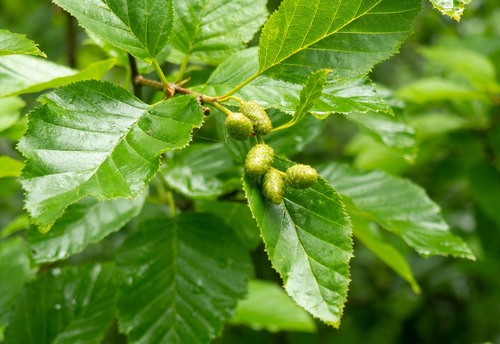
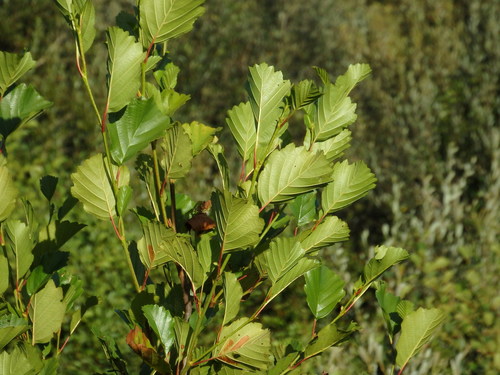
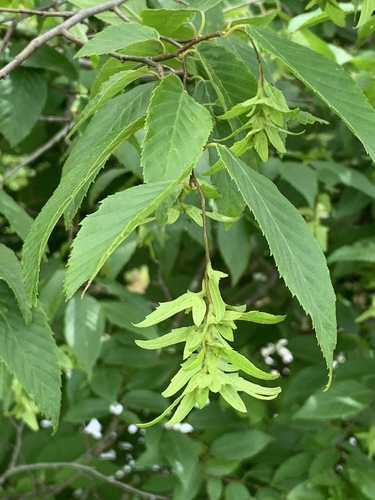
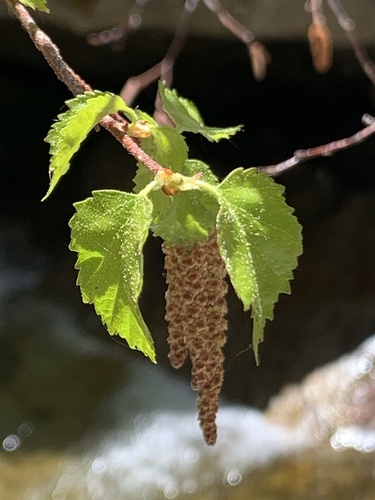
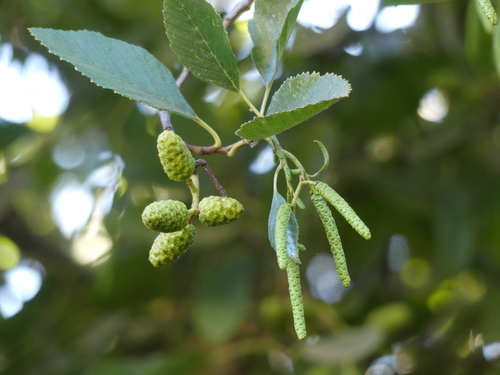
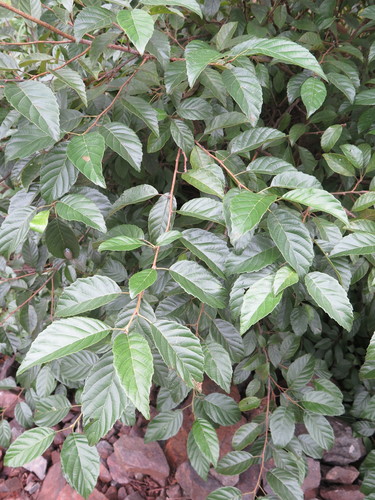
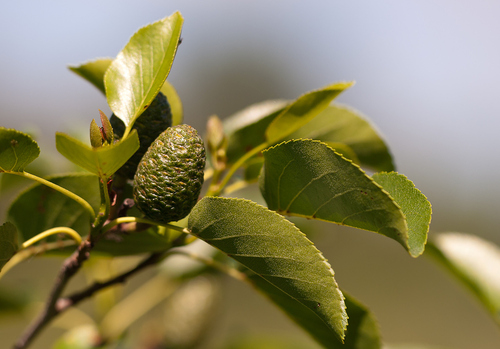
Alnus cordata (Loisel.) Duby is a medium-sized tree that grows up to 25 m (80 feet) tall, exceptionally reaching 28 m (90 feet), with a trunk between 70 and 100 centimetres (30–40 inches) in diameter. It has deciduous leaves that retain their color for a very long growing season, from April to December in the Northern Hemisphere. The leaves are alternate, shaped ovate or circular-ovate with a cordate base, are a rich glossy green, measure 5–12 cm (2–4 3⁄4 inches) long, and have a finely serrated margin. The bark is smooth and greyish brown. The tree’s large leaf area is partially due to its broad crown. Leaf drop typically occurs around late November, and the leaves do not change from their original green color; the green foliage can last until mid-December in some years. Slender cylindrical male catkins are pendulous, reddish, up to 10 cm (4 inches) long, grouped 5 to 6 per cluster. Pollination occurs in early spring, before new leaves emerge. Female catkins are ovoid, and when mature in autumn they measure 2–3 cm (3⁄4–1 1⁄8 inches) long and 1.5–2 cm (5⁄8–3⁄4 inch) broad, ranging from dark green to brown. They are hard and woody, and develop into pseudo-cones. The small winged seeds ripen over winter, changing from green to dark brown, and the pseudo-cones open the following spring to release seeds, which are dispersed by wind. This species grows in three distinct natural growth forms. First, along rivers with abundant space and water, a single base often produces four to six stems that fan out at around 10 degrees from vertical. Second, in open meadows near rivers, marshy ground and flooding can cause trees to angle or tilt; over multiple growing seasons, the trees develop natural bends that return the upper trunk to vertical. It is not uncommon to find Alnus cordata trees with S-shaped trunks formed by two separate tilting events. Third, in dense multi-tree groves, the trees grow thinner and straighter. A grove of 100 trees can provide an excellent renewable source of straight timber suited for woodwork. In cultivation, like other alders, Alnus cordata improves soil fertility through symbiotic nitrogen fixation with the bacteria Frankia alni (also called Actinomyces alni). It grows well in much drier soils than most other alders, and grows rapidly even under very unfavorable conditions. This makes it extremely valuable for landscape planting on difficult sites such as mining spoil heaps and heavily compacted urban sites. It is commonly grown as a windbreak to support soil protection. Alnus cordata is considered a good candidate for bioremediation, because its presence in an ecosystem is linked to beneficial effects including increased organic carbon and nitrogen-rich litter. It has earned the Royal Horticultural Society's Award of Garden Merit. For other uses, researchers have analyzed the phenolic composition of Alnus cordata stem bark, and found that its components have properties similar to those associated with skin-whitening and antioxidant effects. Because the components are rich in antioxidants, they can be safely used to treat skin diseases through their bleaching capabilities. The tree also produces valuable reddish-orange wood. The wood breaks down when exposed to alternating dry and damp air, but is highly durable when kept consistently wet or consistently dry. As seen in the construction of Venice, the wood lasts for centuries when immersed in water. When used in condensation-free buildings with controlled temperature and humidity, it is known to retain a smooth, naturally shiny finish. Carpenters favor this timber, and it is used for turning and carving, moulding, furniture, panelling and plywood.