About Almutaster pauciflorus (Nutt.) Á.Löve & D.Löve
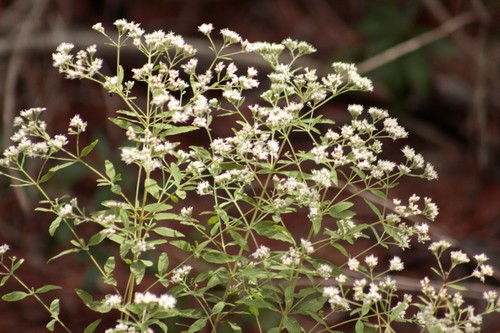
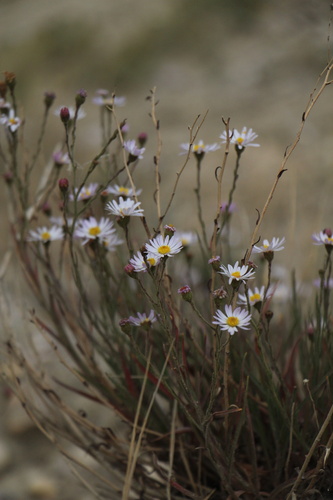
Almutaster is a North American plant genus in the family Asteraceae that holds only one species: Almutaster pauciflorus, which was previously classified as Aster pauciflorus. This species is commonly known as alkali marsh aster. It is native to specific regions: Canada (Northwest Territories and the three Prairie Provinces), the Western United States, and northern and central Mexico, reaching as far south as Tlaxcala. The genus Almutaster is named in honor of botanist Almut Gitter Jones. Almutaster pauciflorus grows in wet alkaline and saline soils, including habitats like inland salt marshes and salt flats. This species is a perennial herb that produces a reddish-green, glandular stem that reaches heights between 30 and 120 centimeters. Its narrow leaves are linear in shape and can grow up to 10 centimeters long. The inflorescence is an open cluster of flower heads, which hold white to pale purple ray florets surrounding a center of yellow disc florets. Each flower head is lined with phyllaries covered in tiny white resin glands. The fruit produced by this plant is a hairy cypsela. The inflorescences of Almutaster pauciflorus serve as a food source for adult Lepidoptera, though these insects may not be the species' principal pollinators.