About Allotropa virgata Torr. & A.Gray
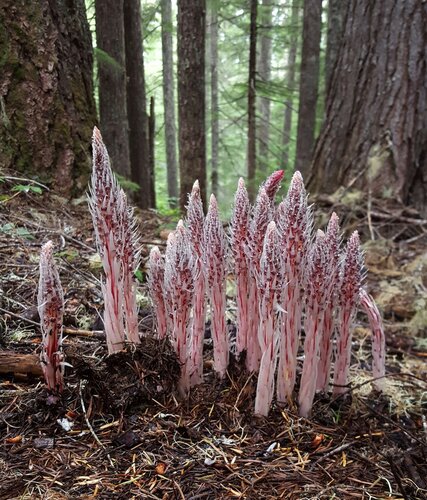
Allotropa virgata Torr. & A.Gray has an underground rhizome (underground stem) that bears brittle roots. Its scale-like leaves grow along a striped peduncle, which holds a raceme-like inflorescence. After seeds are dispersed, the peduncle remains and typically turns brown. The inflorescence bracts measure less than 3 cm long, and the pedicels are not recurved. Mature standing stems reach 15 to 50 centimeters in height. Dead standing stems from previous years' growth are often present; these darken to a reddish-brown and lose all white coloration. Individual flowers of this species usually lack sepals, but when sepals are present, there are between 2 and 4. Flower petals are often incorrectly mistaken for sepals. The corolla is cup-shaped, made up of 5 separate, concave white petals. Ten maroon-colored stamens protrude from the corolla, and these stamens have dehiscent anthers. The species has a superior ovary with 5 chambers, a style shorter than 2 mm, and a disk-shaped stigma. The short nectary is also disk-shaped, with 10 lobes. The fruit of A. virgata is a capsule that splits lengthwise through the ovary wall near the center of each of the 5 chambers. This dehiscence releases the many fusiform seeds contained in each chamber to be dispersed. Allotropa virgata was first collected during the Wilkes Expedition in the Cascade Mountains of Washington in the late 1800s. It grows in oak, coniferous, and hardwood forests of the Pacific Northwest. Its elevational range is 75 to 3000 meters, and it occurs in the High Sierra Nevada, the High Cascade Range, and extends north through British Columbia. Suitable habitat for the species also exists in Idaho, Nevada, and Montana. Ecologically, Allotropa virgata obtains nutrition primarily from the mycelium of matsutake mushrooms (Tricholoma matsutake), and may also feed on the mycelium of the related species Tricholoma magnivelare. It is a clonal species that spreads via its extensive lateral root system. Because it spreads underground through buds that form on its lateral roots, it can survive ground fires so long as the host trees of its fungal hosts are not killed. Allotropa virgata was listed as a 'sensitive' species in 1998. It is pollinated by bumblebees, sweat bees, and some species of Lepidoptera.