About Allobates femoralis (Boulenger, 1884)
Species Introduction
Allobates femoralis is a small frog species.
Size Characteristics
Males grow to 28 to 33 mm (1.1 to 1.3 in) in snout length, and females are slightly larger.
Dorsal and Limb Coloration
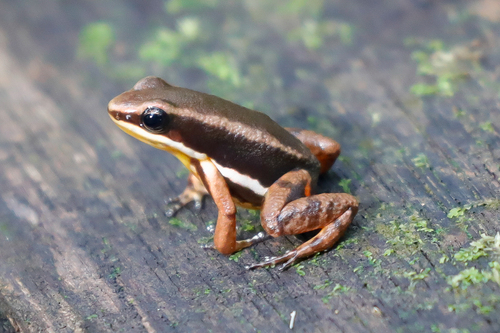
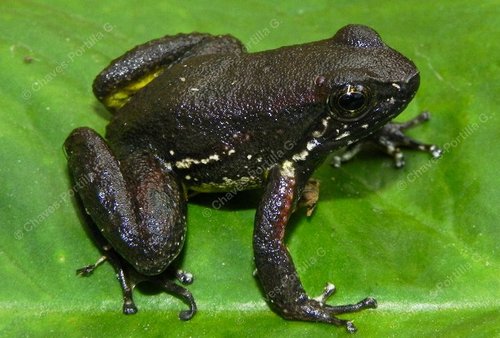
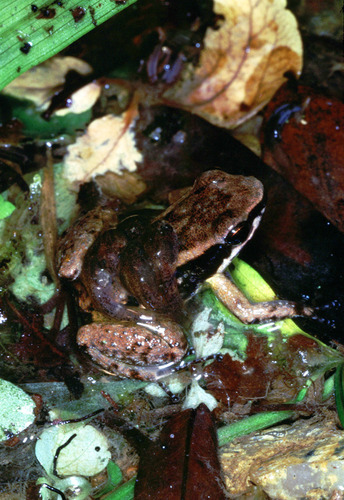
The back is dark brown or black, with dark brown limbs.
Ventral Coloration
The throat is black, and the white belly is marked with black.
Body Stripe Patterns
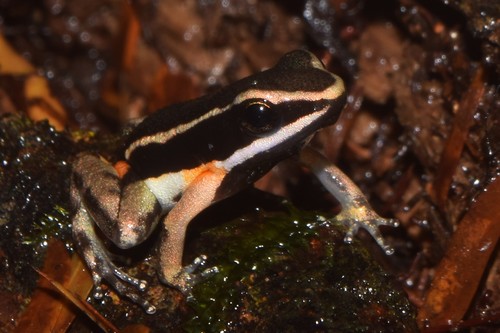
A pale brown dorso-lateral stripe runs from the snout to the base of the legs, and an intermittent white ventro-lateral line runs from the snout past the arm to the leg.
Bright Patch Markings
There is an orange-yellow patch behind the arm, and a half-moon shaped orange patch on the outer side of the thigh.
Similar Species Distinction
A. femoralis has a similar general appearance to Lithodytes lineatus, but L. lineatus has a dorso-lateral line that encircles the back, legs marked with alternating dark and light bands, and two or more orange patches on each thigh.
Overall Distribution
Allobates femoralis is distributed across the Amazon basin and tropical eastern South America.
Confirmed Range Countries
Its confirmed range includes Guyana, Suriname, French Guiana, Brazil, and the eastern parts of Colombia, Ecuador, Peru, and Bolivia.
Unconfirmed Sighting Note
A single reported sighting from Venezuela may instead refer to Ameerega picta.
Habitat Type
This species lives on the forest floor.
Elevation Range
It is most commonly found at elevations below 300 m (1,000 ft), but can occur at up to 1,000 m (3,300 ft) in Colombia and Ecuador.
Behavioral Research Focus
Allobates femoralis is known for its complex behavior and diverse reproductive and parental care strategies, and is particularly well-studied for the fine-scale space use of its non-territorial females, which do not participate in acoustic or visual displays.
Female Activity Centers
In general, females of this species move very little, and spend most of their time in one to three small activity centers.
Female Exploratory Behavior
Even when they leave these activity centers, they do not engage in wide-ranging exploratory behavior.
Female Movement Drivers
Multiple factors significantly influence female movement and space use: subsequent mating events, reproductive behavior, temperature, and cumulative rainfall.
Courtship Period Movement
On afternoons of days when courtship begins, when male calling activity is at its peak, female movement increases considerably.
Mating Movement Cues
Researchers suggest this mating-related movement is influenced by acoustic cues.
Post-Mating Movement
After mating, females leave the oviposition site in the morning when male calling activity is low, leading researchers to conclude that factors other than male vocalization affect where females travel after mating.
Abiotic Movement Factors
Temperature and cumulative rainfall both influence the daily movement of A. femoralis females.
Temperature and Rainfall Effects
Female movement increases at lower temperatures and with higher cumulative precipitation.
Climate Change Susceptibility
Tropical environmental temperatures often fall near the upper thermal limits for amphibians, which makes this species susceptible to climate change, as environmental temperature impacts physiological function and in turn shapes female behavior.
Rainfall and Male Calling
Cumulative rainfall is strongly correlated with male calling activity.
Seasonal Reproduction Timing
On a seasonal scale, male calling activity is higher during wet months, and most reproduction occurs in the late wet season.
Dry Season Reproduction
Reproduction is less frequent and sporadic in the dry season, and these rare dry-season reproductive events are likely triggered by isolated rainfall events.
Rainfall Indirect Effect
Because male vocal signals influence female mating behavior, rainfall indirectly affects female movement by altering mating-related behavior.
Seasonal Rainfall Influence
As rainfall is seasonal, its influence is tied to the timing of female movement.
Male Density Effect
Contrary to the factors listed above, the density of surrounding males does not correlate with female time allocation or space use.
Reproductive vs Non-reproductive Activity
Overall, travel distances and activity patterns on courtship and mating days differ greatly from those on non-reproductive days.
Key Movement Driver
The increased travel distances seen on courtship and mating days indicate that reproductive behavior is an important driver of increased female movement.