About Allium vineale L.
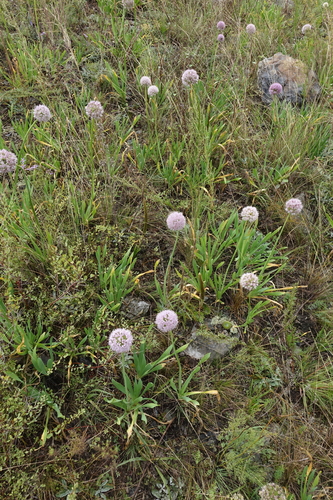
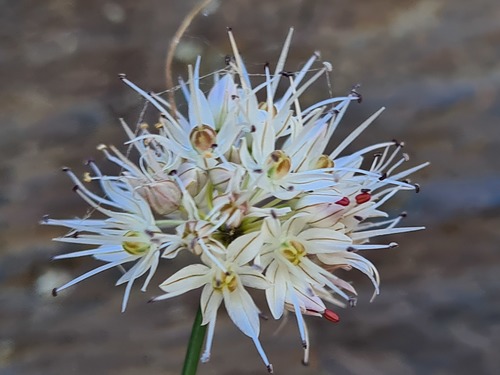
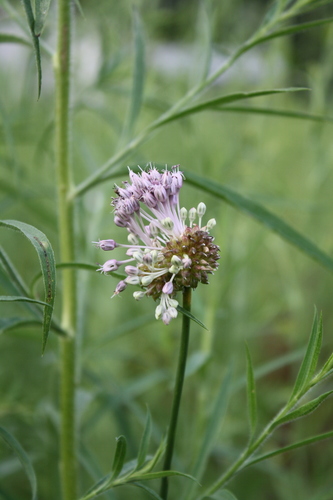
All parts of Allium vineale L. (crow's garlic) have a strong garlic odour. Its underground bulb measures 1–2 cm (0.4–0.8 in) in diameter, with a fibrous outer layer. The main flowering stem grows 30–120 cm (12–47 in) tall, and holds 2–4 leaves plus an apical inflorescence 2–5 cm (0.8–2 in) in diameter. This inflorescence contains a number of small bulbils, and produces anywhere from zero to a few flowers, and is subtended by a basal bract. The leaves are slender hollow tubes, 15–60 cm (6–24 in) long and 2–4 mm thick. They have a waxy texture and a groove running along the side that faces the stem. While these leaves are similar to those of Allium schoenoprasum (chives), they are typically more fibrous, have more vertical grooves, and these grooves are more clearly defined. The inflorescence forms a tight umbel, surrounded by a membranous bract when in bud; this bract withers once flowers open. Each individual flower is stalked, and has a pinkish-green perianth 2.5 to 4.5 mm (3⁄32 to 3⁄16 in) long. Flowers have six tepals, six stamens, and a pistil formed from three fused carpels. Several yellowish-brown bulbils are found mixed in with the flowers. The plant produces a capsule fruit, but seeds rarely develop. Propagation most often occurs when bulbils are knocked off and grow into new individual plants. Plants that produce no flowers and only bulbils are sometimes classified as the variety Allium vineale var. compactum, but this trait is probably not taxonomically significant. Crow's garlic shares an odour similar to true garlic (Allium sativum), produces inflorescences full of bulbils just like garlic, and dies back during the summer. However, its leaf structure is more similar to that of chives (A. schoenoprasum), and A. vineale is more closely related to chives than it is to true garlic. The leaves, flowers, and bulbs of Allium vineale are all edible. It has been suggested as a substitute for garlic, but opinions differ on whether it has an unpleasant aftertaste that common garlic (Allium sativum) does not. When livestock graze on Allium vineale, it gives a garlic-like flavour and odour to both dairy and beef products from the grazed animals. It is classified as a harmful invasive weed in the United States, because aerial bulblets present at harvest can contaminate grain products with a garlic odour or flavour. Wild garlic is tolerant to herbicides, as herbicides cannot adhere well to the vertical, smooth, waxy structure of its leaves. A cultivated variety, Allium vineale 'Hair', is sold as an ornamental plant in the United Kingdom and the United States. This cultivar has unusual flowerheads with purple centres and green, hair-like extensions.