About Allium ursinum L.
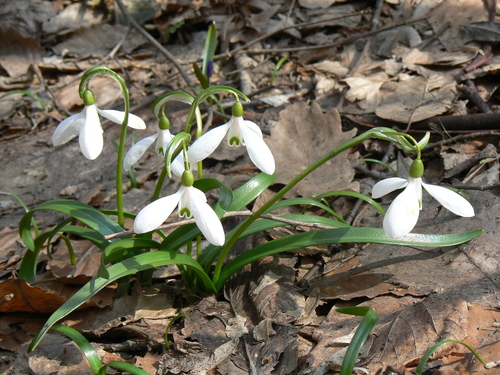
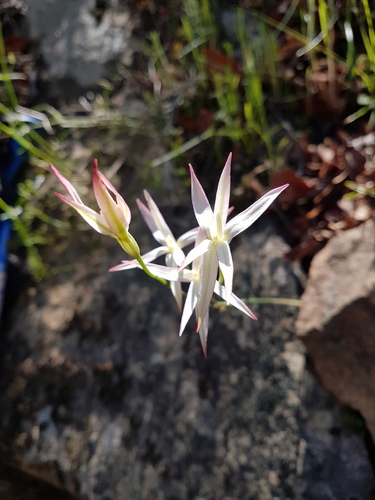
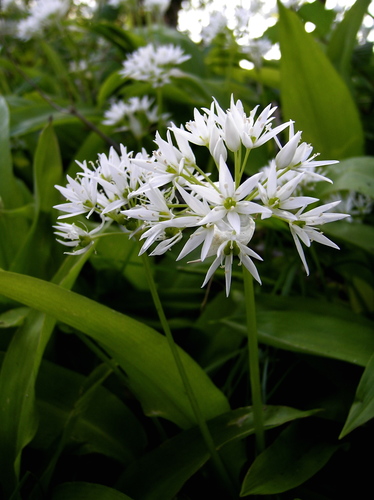
Allium ursinum L. is a bulbous, perennial herbaceous monocot that primarily reproduces by seed. Its narrow bulbs grow from a single leaf base, and produce bright green, smooth-edged elliptical leaves. These leaves reach up to 25 cm (10 in) long and 7 cm (3 in) wide, and each attaches to a petiole up to 20 cm (8 in) long. Its inflorescence is an umbel holding 6 to 20 white flowers, and unlike some other Allium species such as crow garlic (Allium vineale) and field garlic (Allium oleraceum), it does not produce bulbils. The flowers are star-shaped, with six white tepals, and measure around 16–20 mm (5⁄8–13⁄16 in) in diameter; their stamens are shorter than the perianth. In the British Isles, it flowers from April to June, starting to bloom before deciduous trees leaf out in spring. Its flower stem is triangular in cross-section, and its leaves are broadly lanceolate, with a shape similar to the leaves of the toxic lily of the valley (Convallaria majalis).
Allium ursinum is native to Europe and Asia, where it grows in moist woodland. It occurs across temperate Europe from Ireland eastward to the Caucasus. It is common across most lowland areas of the British Isles, except for the far north of Scotland, Orkney, and Shetland. The Allium ursinum subsp. ursinum grows in western and central Europe, while Allium ursinum subsp. ucrainicum is native to east and southeast Europe. It grows in deciduous woodlands with moist soil, and prefers slightly acidic growing conditions. In the British Isles, colonies of Allium ursinum are often found growing alongside bluebells (Hyacinthoides non-scripta), particularly in ancient woodland, and the species is considered an ancient woodland indicator.
As its scientific epithet ursinum suggests, Allium ursinum is an important food source for brown bears, and is also a favored food of wild boar. It is the main larval host plant for the specialized hoverfly Portevinia maculata, also called the ramsons hoverfly. Its flowers are pollinated by bees.
Several poisonous plants are often mistaken for Allium ursinum, including lily of the valley, Colchicum autumnale, Arum maculatum, and Veratrum viride or Veratrum album. In Europe, where Allium ursinum is commonly harvested from the wild, people are regularly poisoned after mistakenly picking lily of the valley or Colchicum autumnale instead. Grinding the leaves between your fingers to check for a garlic-like scent can help identify the plant correctly, but if the scent remains on your hands, you may misidentify a subsequent poisonous plant as safe. When the leaves of Allium ursinum and Arum maculatum first sprout, they look very similar; however, fully unfolded Arum maculatum leaves have irregular edges and many deep veins, while Allium ursinum leaves are convex with a single main vein. Lily of the valley grows leaves in pairs that are dull green, emerging from a single reddish-purple stem; by contrast, each Allium ursinum leaf grows on its own individual stem, and new leaves are shiny and bright green.
All parts of Allium ursinum are edible. Its leaves can be eaten as salad, used as a culinary herb, boiled as a vegetable, added to soup, or made into a sauce that can replace basil pesto. Leaves are also commonly used to make garlic butter. In Russia, the stems are preserved by salting and eaten in salads. A variety of Cornish Yarg cheese has a rind coated in wild garlic (Allium ursinum) leaves. Its leaves can be pickled the same way that Allium ochotense, known as mountain garlic in Korea, is prepared. The bulbs can be used just like garlic cloves, and the flowers are also edible. It is used to make Van herbed cheese, a specialty of Turkey's Van province. Popular dishes made with the plant include pesto, soups, pasta, cheese, scones, and Devonnaise. The plant's leaves are also used as fodder for livestock. Cows that feed on Allium ursinum produce milk with a slight garlic flavor, and butter made from this milk was popular in 19th-century Switzerland.
The earliest evidence of human use of Allium ursinum comes from the Mesolithic settlement of Barkær in Denmark, where an impression of an Allium ursinum leaf has been discovered. At the Swiss Neolithic settlement of Thayngen-Weier, which belongs to the Cortaillod culture, a high concentration of Allium ursinum pollen was found in the settlement layer; some researchers interpret this finding as evidence the plant was used as fodder there.