About Allium triquetrum L.
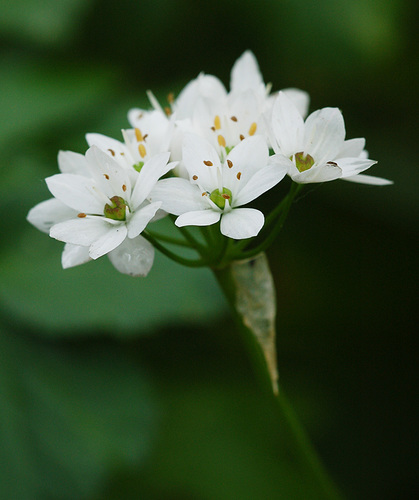
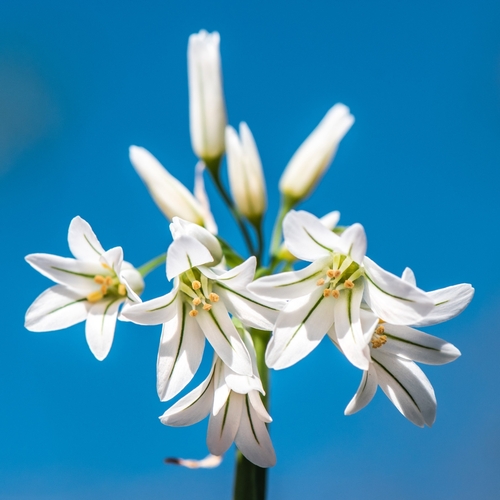
Allium triquetrum L. produces stems between 17 and 60 cm (6+3⁄4 to 23+1⁄2 inches) tall, with a concave triangular cross-section. In winter and spring, each stem grows an umbel inflorescence holding 4 to 19 flowers. Its tepals are 10 to 18 mm (13⁄32 to 23⁄32 inches) long, white, and marked with a distinct strong green line. Each individual plant produces 2 to 3 narrow, linear leaves that grow up to 15 cm (6 inches) long; these leaves give off a strong onion scent when crushed. This species is native to southwestern Europe, northwestern Africa, Madeira, and the Canary Islands. In its native range, it grows in meadows, woodland clearings, river banks, and roadside verges, from sea level up to 850 metres (2,790 ft) in elevation. It has been introduced to Great Britain, Ireland, the Azores, New Zealand, Turkey, Australia, California, Oregon, and South America, and is classified as a declared noxious weed in some of these introduced locations. It has also been recorded growing as an alien species at a garden waste site on Howth Head, Ireland. All parts of Allium triquetrum, from the bulb to the flowers, are edible either fresh or cooked. It can be used in cooking in the same way as spring onions and wild onions, since it resembles these species both in morphology and flavor.