About Allium scorodoprasum L.
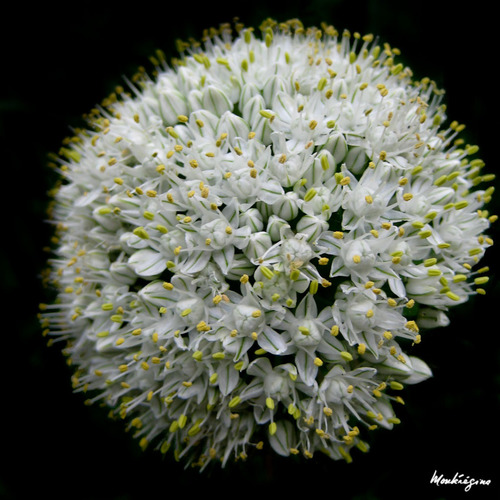
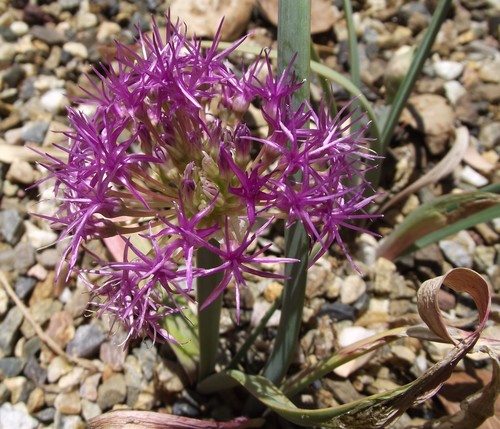
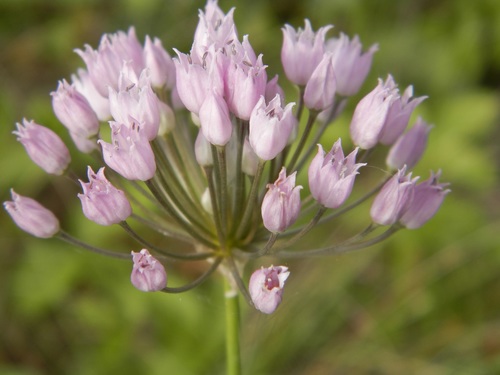
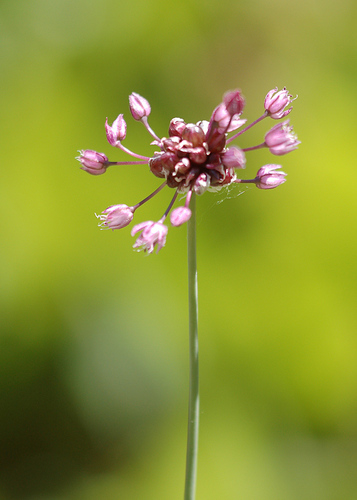
Allium scorodoprasum L., commonly called sand leek, is a perennial plant that forms an egg-shaped bulb. It produces two to five unstalked leaves, with sheath-like leaf bases. Each linear leaf blade is 7–20 millimetres (1⁄4–3⁄4 in) wide, flat with a slight keel, has an entire margin and parallel veins. The leaf edges and central vein are rough to the touch. Its cylindrical flowering stem grows 30 to 90 cm (12 to 35 in) tall, and its upper half is leafless. The entire plant has an onion-like aroma. The inflorescence is a globular cluster, surrounded by membranous bracts when in bud; these bracts wither once the flowers open. Each individual flower is stalked and has a purple perianth 4 to 7 mm (1⁄8 to 1⁄4 in) long. It has six tepals, six stamens, and a pistil formed from three fused carpels. A number of purple bulbils grow mixed among the flowers. The fruit is a capsule, but seeds rarely form. Propagation usually occurs when bulbils are knocked off and grow into new plants. The natural habitat of A. scorodoprasum includes damp broad-leaved woodland, forest margins, shores, hillside meadows and hedgerows. It was once used as a kitchen herb, and can occasionally be found near old habitations. A. scorodoprasum is edible, but it is rarely cultivated. It has a shorter flower stalk, and fewer, more inconsistently shaped cloves, than Rocambole garlic. Sand leek also has a dark violet bulb wrapper. Elephant garlic, properly A. ampeloprasum var. ampeloprasum, is also sometimes incorrectly sold as A. scorodoprasum. The bulbs and flower bulbils of sand leek can be cooked similarly to garlic, and have a milder flavor.