About Allium robinsonii L.F.Hend.
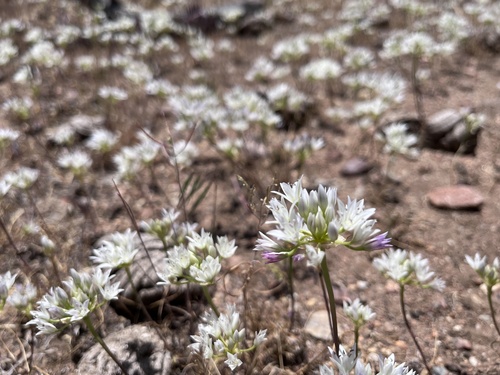
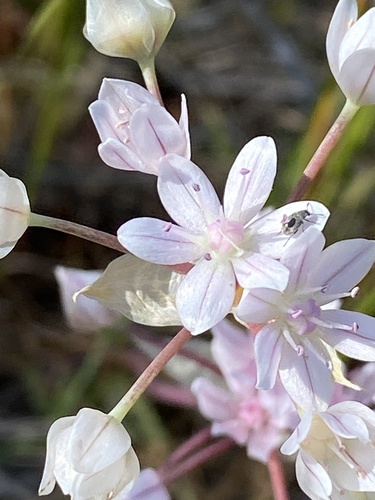
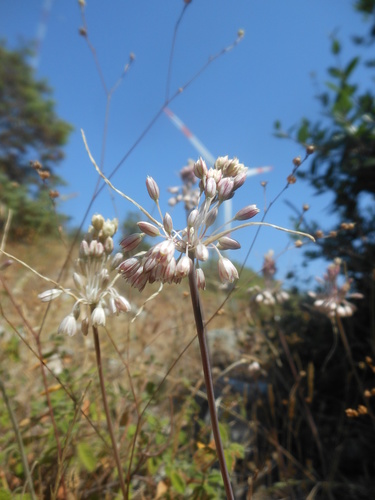
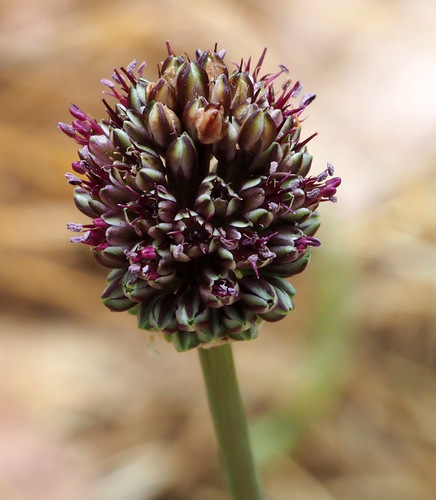
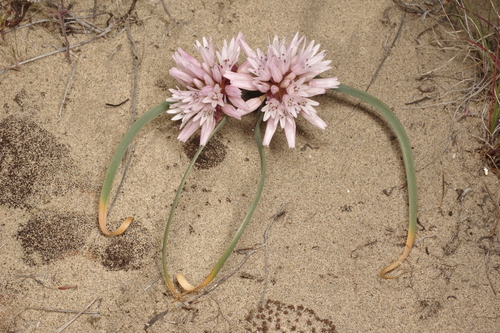
Allium robinsonii, commonly known as the Columbia River onion or Robinson's onion, is a rare plant species native to the U.S. states of Washington and Oregon. Some studies indicate that Oregon populations of this species may now be extinct. It has been recorded from five counties in Washington: Ferry, Yakima, Grant, Franklin, and Benton, and five counties in Oregon: Umatilla, Morrow, Gilliam, Sherman, and Wasco. It grows in sand and gravel deposits along the lower Columbia River and some of its tributaries, usually at elevations below 200 m. This species is also cultivated as an ornamental plant in other regions, including Europe. Allium robinsonii produces 1 to 3 egg-shaped bulbs that can grow up to 2 cm long, and it does not produce underground rhizomes. Flowering stalks of this species are relatively short compared to others in the Allium genus, rarely reaching more than 8 cm in height. Its flowers are bell-shaped and up to 9 mm across; tepals range from white to pale pink with red midribs, anthers are purple, pollen is yellow or gray, and the ovary is crested. The species is named to honor B. L. Robinson of the Gray Herbarium of Harvard University. Its leaves are flat and succulent, and they remain on the plant while it is flowering.