About Allium paradoxum (M.Bieb.) G.Don
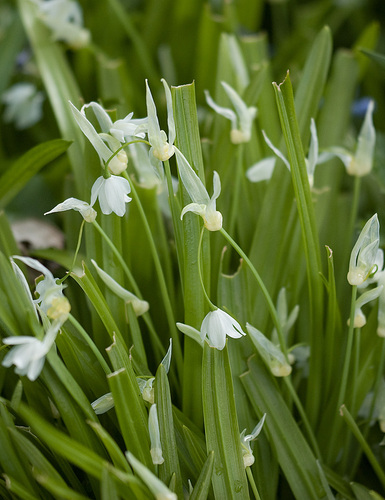
Allium paradoxum is a herbaceous perennial that grows from a small solitary bulb, reaching a height of 20–40 cm (7.9–15.7 in). Its leaves are 5 to 25 mm (0.20 to 0.98 in) wide, which is much narrower than the leaves of Allium ursinum, though it shares a similar garlicky scent. The flower stem has a triangular cross-section. Most of its flowers are replaced by small bulbs called bulbils; the few full flowers produced (usually only one) are white and hermaphrodite. The scent of Allium paradoxum becomes particularly noticeable as one approaches an area where it is growing. Allium paradoxum is native to mountainous regions of Iran, the Caucasus, and Turkmenistan. It was introduced to the British Isles in 1823, and was first recorded growing wild there in 1863 near Edinburgh. It is typically a lowland plant; the highest elevation record for the species in Britain is from Carter Bar at 375 m (1,230 ft). It is classified as an invasive non-native species in Europe. In England and Wales, it is listed on Schedule 9 of the Wildlife and Countryside Act, making it illegal to plant this species in the wild. Allium paradoxum grows well in deciduous woodland habitats, where it forms a dense green carpet that can smother native species including bluebells and snowdrops. It also grows in a range of other habitats, including river banks, rough pasture, field edges, roadsides, and wasteground.